Certain signs can show "who did what to whom" through their movement. The movement of the sign indicates the subject and the object of the verb. For example, if I sign "money" and then I sign "give" starting near my body and moving the sign "give" in your direction, then I'm signing "I will give you some money," or "I gave you money." Suppose I start the sign by holding the sign away from my body (in whatever direction you are) and then move the sign "give" toward me and end near my body...that would mean, "You give me some money."
If I look at you and move the sign "give" out to my right or left, I am signing "Give it to him."
This "directionality" can be used with many (but not all) signs. How do you know which ones? You associate with skilled users of the language and pick up on it, or you watch many videos of skilled signers, or you attend many classes, pay attention, and ask questions about signs.
You can directionalize many different verbs. Hand-to is the best example, but "MEET" is also useful. [To sign MEET, you hold both index fingers out in front of you about a foot apart, pointed up, palms facing each other. Then you bring them together--it looks like two people meeting. Note: The index fingers do not touch, just the lower parts of the hands.]
For example ME-MEET-YOU can be done in one motion. I don't need to sign "I" "MEET" "YOU" as three separate words. But rather I hold my right Index finger near me, palm facing you, and my left index finger near you, palm facing me. Then I bring my right to my left. One motion is all it took.
A student asks: How do we know which verbs to use?
Response: That takes interactive practice and study. Some verbs just aren't directional in nature. For example: "WANT." You sign "WANT" and separately indicate who wants what. For example, to sign "SHE WANT CANDY" you'd point at the little girl, sign "WANT" then sign "CANDY."
(Just a side note: Even though "WANT" is not "directional" it does use a certain other interesting ASL grammar feature. "WANT/DON'T-WANT" is an excellent example of reversal of orientation for negation.)
Dr. Bill: Suppose I index BOB on my right and FRED on my left. Then I sign "GIVE-TO" from near my body to the place where I indexed Bob. That means, "I give to Bob."
If I sign GIVE-TO starting the movement from the place off to the right and move it to the left it means Bob gave to Fred. If I sign starting from off to the left and bring the sign GIVE TO toward my body what would it mean?
Sandy: "Fred give to me?"
Dr. Bill: Right.
Okay, so let's review "Directional Signs." Another name for this concept is "agreement verbs." These are verbs that incorporation information about the subject and object (the doer and receiver of the action). That means you don't have to use a separate sign for the subject and/or object when you use a directional verb. This is known as "agreement." Or "subject-object agreement."
A good example of this kind of sign is "GIVE."
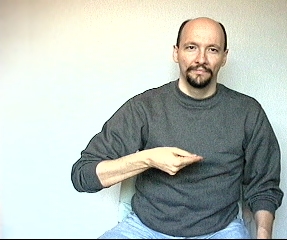
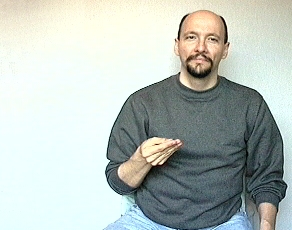
If I wanted to indicate "HE GAVE IT TO ME," all I'd need to do is start the sign "GIVE" from a location that is farther away from my body and end the sign nearer to my body.
On the other hand, if I wanted to indicate, "I gave it to him, I'd sign:
Visit the "GIVE" page for more examples.
Notes:
In a message dated 12/28/2012 1:33:15 P.M. Pacific Standard Time, dcm254 writes:
I notice on the Lifeprint site you mention directionality of signs often. When I used directionality for the sign HELP a while back, my friend looked at me very confused. She then asked what I was doing. I explained, and she called me stupid and said deaf people will think I'm dumb (she can be very blunt sometimes ha ha).
Anyway, I know she has lived in the Pittsburgh and Florida areas. Is her lack of recognizing directionality perhaps a regional thing? Or maybe she and her friends happen to be people that don't use/recognize it? I was wondering your thoughts on it.
Thank you,
Daniel
Dear Daniel,
Honestly? I think you need to expand your circle of "Deaf friends" so that you have about 10 people to discuss things with. You'll quickly find that any two Deaf people tend to have quite a few differences in the way they sign things (unless they are an old Deaf couple who have lived together "forever" -- or have a parent / child relationship).
Ask your Deaf friend how she would sign "He gave it to me."
If she uses more than "one" sign to do that phrase, ask her if she knows of a faster or shorter way to sign "he gave it to me."
If she is unable to show you how to sign that phrase using just one sign (the one-handed GIVE sign, starting off to the side and moving back to the body) that would indicate she is not familiar with the advanced features of ASL exhibited by socially active native-Deaf adults.
Phrases like:
* Move-to-here
* Drive-to-here
* Looked-at-me
* Said-NO-to-me
Each of those phrases can be done "directionally" with just one sign.
Note: you might indeed be screwing up your signing of the concept "HELP." I don't know exactly how you are signing it. I'm not there to see how you might be messing it up.
Not all signs are directional. Some are. Some are not. It takes exposure (or direct study) to learn which ones are and are not.
- Dr. Bill


Notes: