The sign for "here"
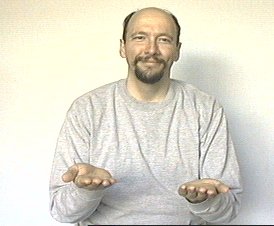
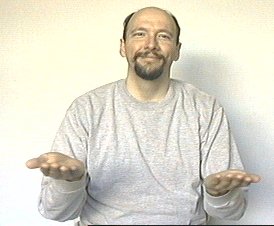
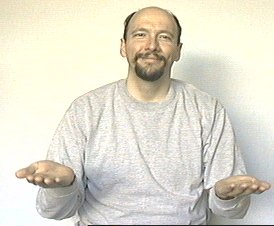
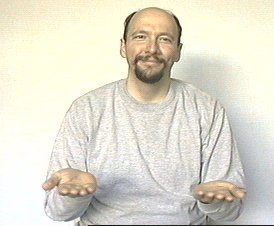
Main version: HERE
0:00 / 0:00
Handshape: Both hands are in a relaxed flat hand shape.. By "relaxed" I mean the fingers can be together, or they can be loosely separated. The hands are not "rigidly" flat, but have a very slight curve. The thumbs are open a little bit, but certainly not "extended."
Location: Out in front of you, about belly height.
Orientation: palms facing up
Movement: Each hand moves in a small circle. They don't go up and down. They both move forward, then out to the side, then back toward the body, then in towards each other.
Non-Manual Marker (Facial expressions and or body language) neutral.
The sign "THIS" can be used to mean "here" as in "this place."
THIS / here:
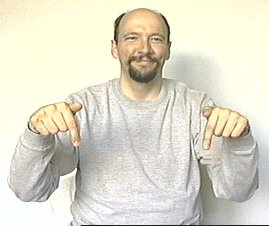
You can also indicate "here" as in the "immediate vicinity" by pointing at the floor, raising your hands an inch then lowering them an inch.
"Right here in this very place."
0:00 / 0:00
Notes:
The pointing version of HERE is more of a "right here" or "this very place." The pointing version can be used at the end of the sign "come" to mean "come here." The point at the floor version is also used as a common single-sign response to "where" questions: "Where's the party?" "Here."
The flat hand version is the general sign for HERE and means "this location" in general.
Question:
A student asked: What is the difference between the sign "need" and the second version of the sign for "here?" (The index finger pointing down.)
Answer:
HERE-[index-finger-version] vs NEED
The sign we commonly label as "need" can also be inflected to mean ought to, should, have to, must, etc. -- using more or less force and stronger or gentler facial expressions. The sign for "need" uses a "crooked" index finger (also known as an "X" hand). The sign need generally bends at the wrist but can involve some elbow movement.
The concept of "here" can be signed by using the formal sign consisting of palm up flat hands but also can be signed by simply pointing downward with a straight index finger. The movement is mainly in the elbow without much movement in the wrist
Pointing downward can create a variety of meanings depending on context. Such meanings can include: this, here, it-(when something is below the speaker), foot, and down.
Compare:
NEED / should / ought to / have to ...
https://youtu.be/Eo-vEE1gFxM
vs
THIS / here / foot / down...
See: https://youtu.be/hfa0GQG-LYA




Notes: