LEARN
STUDENT (or "Learner" = "LEARN-PERSON")
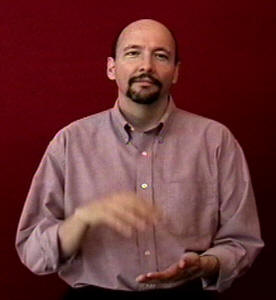
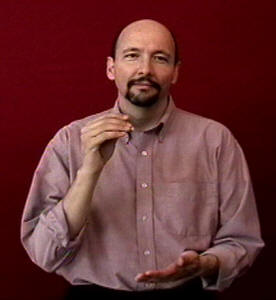
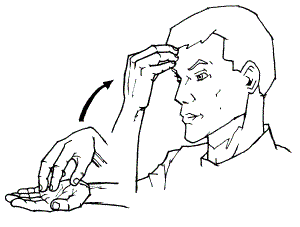
LEARN: Memory hint: Think of grabbing information from a book or piece of paper and placing it in your head.
Note: Don't actually do it this way. It is just a memory aid:
A student asks: On the practice quiz, one of the questions shows a double motion of the sign for "LEARN." I checked the answer list and found that it means "learning." I don't recall seeing this in any of the lessons. Can I apply this as a general rule (with exceptions) to all verbs? That'd be cool.
Response: Actually "LEARN" is already a verb. The double movement of LEARN can create the "-ing" form of the verb (or it can create the noun form). This is the same in English -- "learning" can function as either a noun or a verb -- depending on context and how you use it.
Typically if you do the sign LEARN twice it:
1. Turns it into a noun
2. Turns it into a process (or more technically a "gerund or present participle form of the verb -- for example "I am learning."
Signs that can function as a verb if done once and a noun if done twice are called "noun / verb pairs." If you do a noun/verb type sign once it forms the standard verb, if you do the sign twice it might become a noun (for example: SIT if done twice -- becomes CHAIR) or the repeated sign can become a process (for example, "teach" becomes "teaching").
In a message dated (a long time ago) 1:19:12 PM Central Daylight Time, adeletc@yahoo.com writes:
Hi! This is Adele here. I don't know if you remember me... I sent you an email a couple weeks ago... Anyway, I have a couple of questions for you. First question: I'm having a hard time understanding the sign for LEARN... I don't have anyone to practice these signs with, so I'm not sure if I'm doing it
right.
Adele,
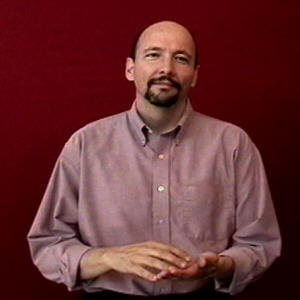
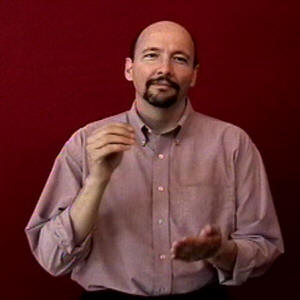
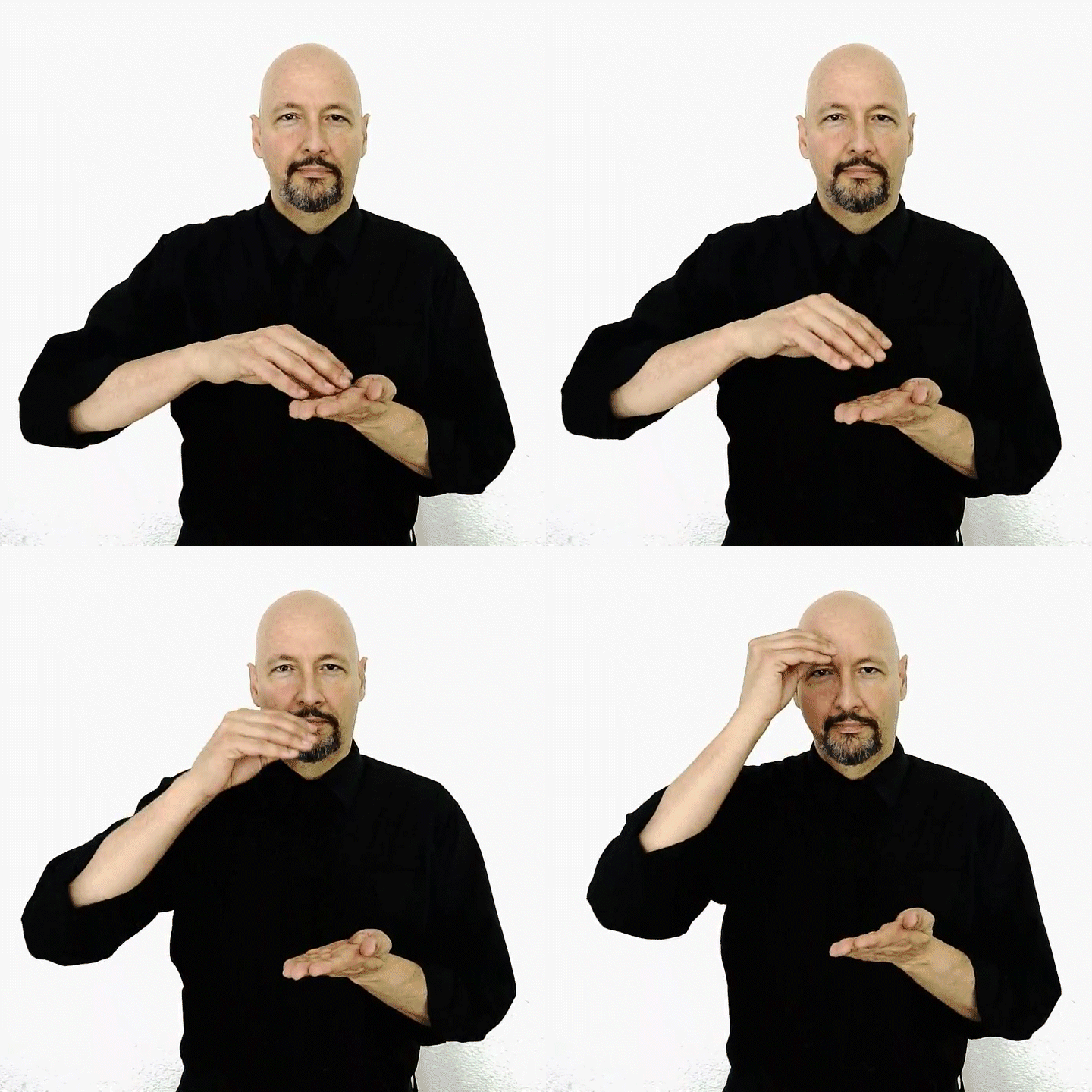
A hint for the sign "learn" is to hold your left hand out and pretend there is "information" sitting on the palm. Pick up that information with your fingertips and thumb tip and lift it up toward your head as if you plan on sticking it in your head.
The higher you go the more "full" the version of the sign.
However, I encourage you to use a more casual version of the sign. Just lift the "information" off the left palm but only bring it partway toward the head.
Look in the mirror and see if it looks like my example in the pictures. Plus, try to find a Deaf friend to sign with.
- Dr. Bill
In a message dated (a long time ago) 1:15:16 PM Pacific Daylight Time, adeletc@yahoo.com writes:
Dear Dr. Bill,
Thank you so much for your wonderful responses! I found them most interesting. Anyway, I now understand the sign for LEARN, but my problem is, I was doing that sign for STUDENT. So I think I was signing STUDENT wrong. Are they similar signs?
-Adele
Adele,
The sign for student starts out the same as the sign for learn and then uses the "agent" suffix. That means that you add the "person sign" sign "PERSON" to the sign LEARN to make the sign mean STUDENT.
In real life, deaf people often abbreviate the sign student and it looks sort of like you are throwing away a piece of paper! The right hand grabs a piece of "something" from the left palm then both hands become "flat hands" (palms facing inward) and move down a couple inches.
- Dr. BillLEARNING-[version]
0:00 / 0:00





Notes:
Where this sign is taught:
Taught in Lesson 01.Reviewed in lessons: 10, 11, 30, 31, 33
Practice sentences using this sign:
YOU LEARN SIGN, WHERE? (Where are you learning sign?)YOU LEARN SIGN, WHY ? (Why are you learning sign?)
THEY LEARN SIGN? (Are they learning sign language?)
YOU LIKE LEARN SIGN? (Do you like learning sign language?)
YOU LIKE LEARN SIGN? (Do you like learning sign?)
LEARN SIGN, NEED HELP YOU? (Do you need help learning sign language?)
YOU WANT STOP LEARN SIGN? (Do you want to stop learning sign language?)
YOU LIKE TAKE CLASS CLASS LEARN KNOW ANIMAL? (Do you like taking classes about and learning about animals?)
LEARN NEW THING YOU LIKE? (Do you like to learn new things?)
YOU START LEARN LEARN SIGN, WHEN? (When did you start learning how to sign?)
... and 1 more practice sentences use this sign.