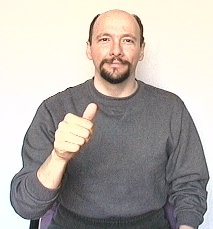
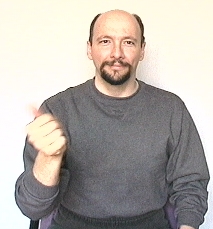
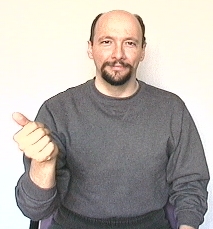
The sign for "other" is very similar to the sign for "TEN."
I tend to use a double motion for the sign "TEN" and a single motion for "OTHER." But I do on occasion sign "TEN" using just a quick, single motion. It depends on if you are feeling "more definite" you'd use the single motion. You can also use this sign to mean "else."
OTHER / else:
Sample sentence: "Who else in your family knows sign language?" = "YOUR FAMILY, WHO ELSE SIGN?"
Also see: ANY
Notes:
I recall observing a friend, (whom I consider a master communicator) teach a class of Deaf students. I watched this teacher inflect the sign "OTHER" with a very quick, small, double motion and a wh-q (furrowed eyebrows, slightly tilted head) facial expression. He was doing it as his response to an incorrect answer from a student. He had asked a question, (the student responded), then instead of saying "wrong" this skilled communicator signed "OTHER" using the repeated motion and holding the sign in place for an extended time. I thought to myself, "WOW! What a great way of getting your student to try a different answer without having to label him or her as being wrong." Using just one sign what he communicated was, "That is not the answer I'm looking for, can you tell me some other possible solution to my question?"Bravo!
Question: Is there a good way to differentiate between 'other' and '10' other than context?
Answer: The sign "TEN" and the sign "OTHER" may sometimes be indistinguishable out of context. Both signs have versions and can be inflected (marked).
Of the two signs the sign TEN tends to be more compact and stay in the same location with less shifting of the base position. It can be wiggled for clarity and/or to create a meaning of "about 10" or "maybe 10" (when paired with an uncertain facial expression).
Of the two signs, the sign OTHER tends to be done with a comparatively larger movement. The sign OTHER also has a version that uses a repeated small wiggle movement used to encourage a conversation partner to keep guessing or trying to get the right answer. This wiggle is done with the thumb more toward the dominant side than the wiggle version of the sign 10 (which is more pointed upward).
If I needed to sign a sentence such as: "I have ten other friends" -- I would do the sign TEN unmarked using one quick movement in the normal location followed by doing the sign OTHER using an emphasized arching movement further toward the dominant side. Many Deaf also include a mouth movement when needed to help distinguish TEN from OTHER. The mouth movement is not a "rule" however it is also an undeniable occasional addition (by a significant number of Deaf signers) to signs that would otherwise be ambiguous (particularly in low context situations).
Notes: