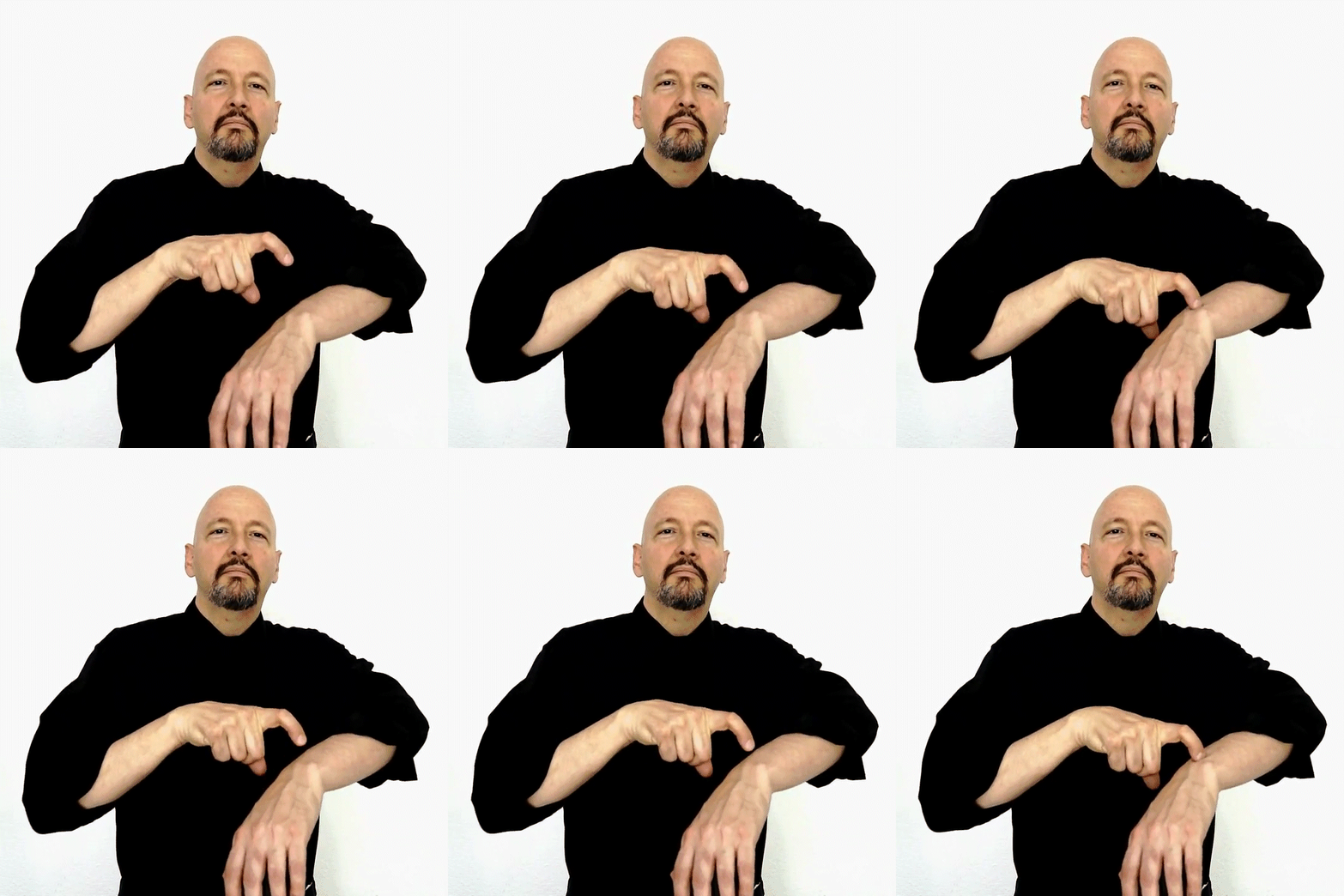
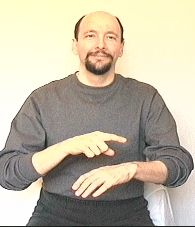
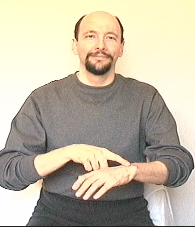
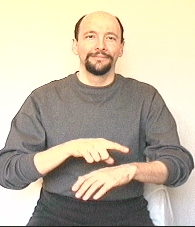
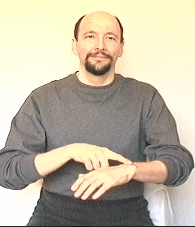
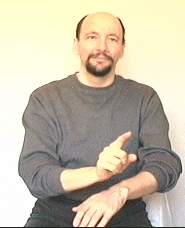
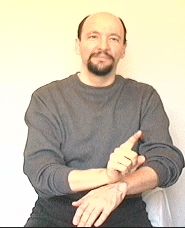
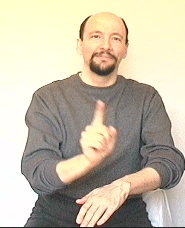
The sign for "time" in ASL points to the wrist at the location where people used to wear watches, (before cell phones). Just tap your wrist twice. If you want to know "What time is it?" then do this same sign but with furrowed eyebrows.
TIME:
What time do you go to ASL class?
STUDENT: "How would u sign " on time"? would u sign "on" and then "time?"
Dr. Bill: You do not use the sign ON for the concept of "on time."
Instead, you should do a modified version of TIME by starting the movement from about 7 inches above the wrist, coming down quickly, touching the wrist without stopping and then moving back up 5 inches. The whole movement is very quick. Think of a scorpion stinging.This sign could be used to mean "punctual" or 7 p.m. "sharp!"
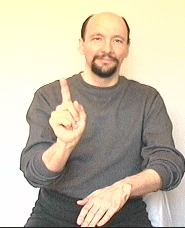
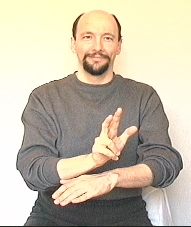
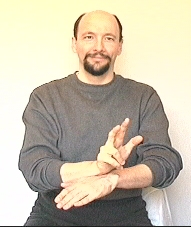
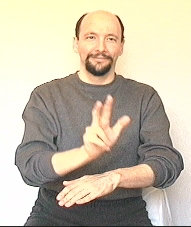
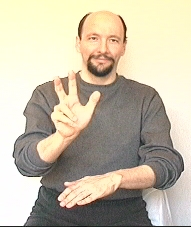
Incorporation of number in time: example: "1 o'clock."
animation
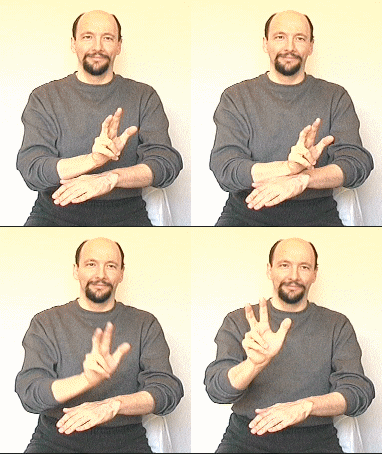
Three o'clock:
animation
a.m. and p.m.
You can indicate "a.m." by signing "morning," or "p.m." by signing "evening."
Time Line:
The general concept here is that you have a timeline that runs from behind you to in front of you. By doing a sign farther back you can indicate the concept occurred further in the past. The farther forward things are signed, the further in the future they are. Doing a sign close to your body can be used to indicate the nearness or recentness of an event.
Dealing with time:
In English a person might say, "I went to a movie last Saturday." Or, maybe "Last Saturday I went to a movie." Notice how the concept of "go" is expressed as "went?" This is called "conjugating" the verb to show tense. (Conjugate is just a big word that means "change" or "join.") Another word for conjugate is "inflect."
In ASL that sentence would be signed "PAST SATURDAY ME-(PRO1) GO MOVIE." (The "PRO1" means a first person pronoun, which is done by simply pointing at yourself with an index finger.) We use the same form of the concept "GO" for both present and past tense sentences. That is the way it is with most ASL sentences. We establish the "tense" or time-frame of a sentence by using certain "time signs" like "past week," "next month," "now morning," or "next year," and then the rest of the sentence uses typical non-conjugated signs. This technique works for whole paragraphs and/or conversations. Tense only needs to be established once at the beginning of an ASL conversation. All of the remaining signs use the same form regardless whether you are talking about the past, present, or future. For example, in the sentence, "TOMORROW ME-(PRO1) GO MOVIE" uses the same sign for "GO" as the sentence, "YESTERDAY ME GO MOVIE."
Now note, that the interpretation of "NOW AFTERNOON ME-(PRO1) GO MOVIE" depends on what time of day it is. If it is morning, then the sentence would be the equivalent of, "This afternoon I will go to a movie." If it is currently night time, the sentence would be interpreted as, "Today I went to a movie." The ASL signs are the same, but their meaning depends on what time of day the sentence is being signed.
Dear Dr. Bill,
I have a question concerning time. Is the sign the same if you were saying "every time" or "the last time"?
- Janice
Dear Janice,
Depending on the circumstance, "every time" might be signed " EACH TIME, ALWAYS, ALL TIME, PERIOD, NO-MATTER, etc.
How you sign "the last time," depends on whether you mean "final/concluding" or "the most recent time." If you mean "the last time" as in "This is the last time we will visit this restaurant" you would use the version of the sign "LAST" that strikes the pinkie of the non-dominant hand with the pinkie of the dominant hand. If you mean, "The last time I visited this restaurant was five years ago," you would use a combination of signs including "PAST/previously" and the sign "SINCE/up to now" combined with appropriate facial grammar (slight negative head shake to indicate "haven't"). I TOUCH HERE 5-YEAR-AGO, SINCE NONE.
Thus, the traditional sign "TIME" might not even show up in the sentence.
Cordially,
- Dr. Bill
(Lifeprint.com)
Also see: "From time to time."
Also see: "TIME-PERIOD"

Notes: