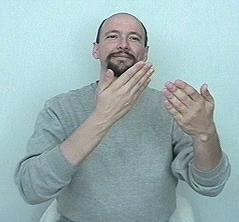
The sign for "arrive" uses flat hands ("B"-hands). The non-dominant hand is held out away from the body with the palm angled in toward your chest and a bit upward. The dominant hand starts near your body, palm back, and moves forward until it slaps into the palm of the non-dominant hand.
Memory aid :The dominant hand arrives at the non-dominant hand.
ARRIVE / get to / make it there:
0:00 / 0:00
Sample sentence: YOU ARRIVE CLASS what-TIME? What time do you arrive at class?
0:00 / 0:00
Notes:(Not needed for class. No need to read.)
Question: Is "ARRIVE" the same sign as "PROVE/proof/evidence?"
Answer: The two signs are somewhat similar but there are some differences. ARRIVE is angled more upright, (mostly palm-back). PROVE starts with the non-dominant hand generally horizontal, and palm facing upward. Then the dominant hand smacks down onto the non-dominant hand and bounces up an inch or two. Visualize the non-dominant hand representing a table or similar surface and the dominant hand representing a folder full of documents that you throw down onto the table that prove your point.


Notes: