American Sign
Language
Fingerspelling & Numbers:
Introduction
Current links:
1 |
2 | 3
| 4 | 5
| 6 | 7
| 8
| 9
|
10
| 11 |
Topics this page:
Welcome |
Definitions
|
Discussion
|
Proficiency Objectives
| Charts
|
Resources
Welcome:
This course will help you become proficient at American Sign Language
(ASL) fingerspelling and numbering. The course is intended for Hearing adult second-language learners who
are familiar with English, learning ASL, and reasonably computer
literate.
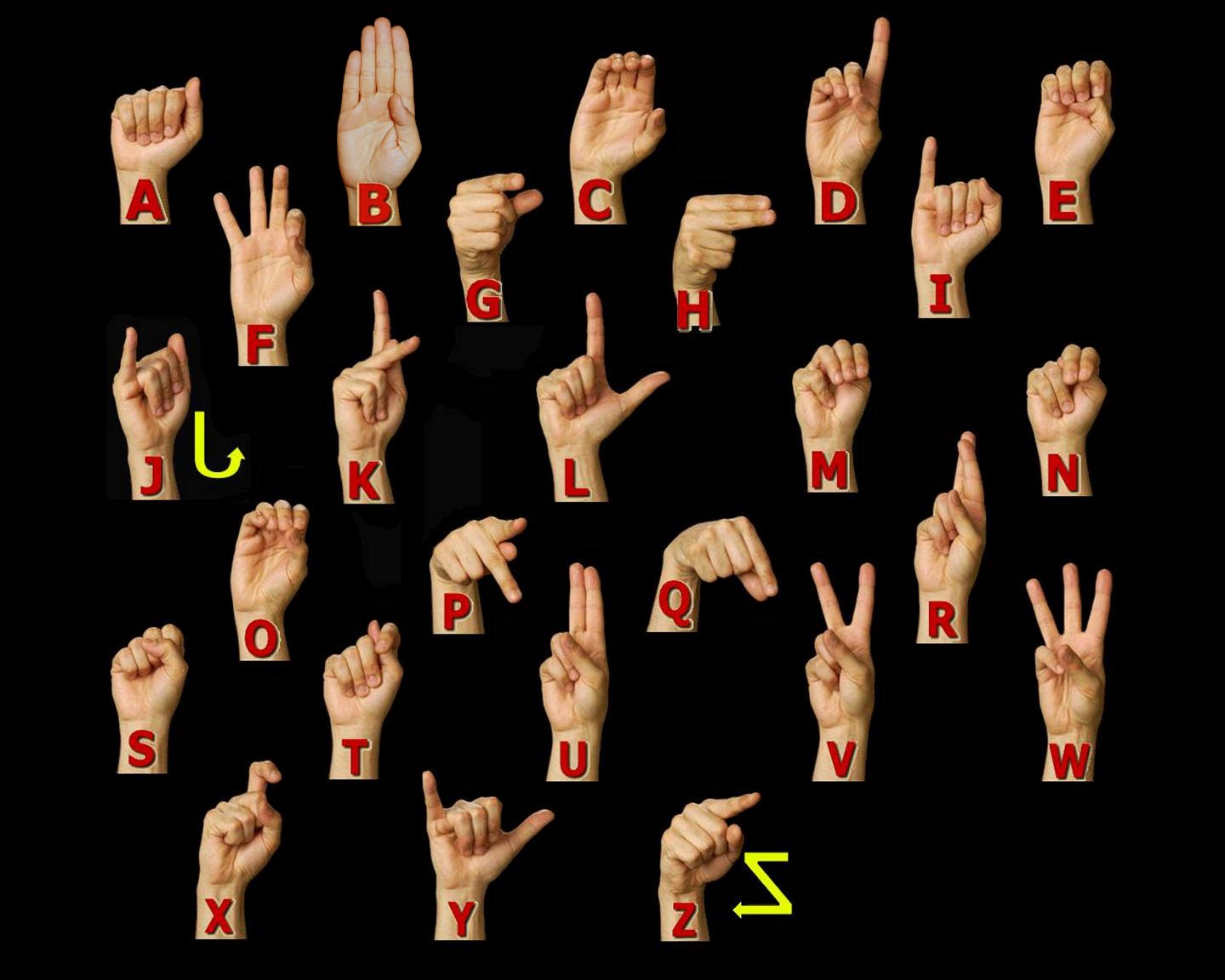
Definition
Question: What is fingerspelling?
Answer: Fingerspelling is the process of
spelling out words by using hand shapes that correspond to the letters of
the word. A set of hand shapes used to spell words is know as
a "manual alphabet."
There are many different manual alphabets throughout the world.
American Sign Language uses the ASL Manual Alphabet. You may
also see the ASL Manual Alphabet referred to as the American Sign
Language Fingerspelled Alphabet.
The American Fingerspelled Alphabet consists of 22
handshapes that--when held in certain positions and/or are produced with
certain movements-- represent the 26 letters of the American alphabet.
Discussion
Question: When should you use fingerspelling?
Answer: There are lots of times when
fingerspelling is used.
The typical "these things are spelled" list includes such items as:
- people's
names
- places
- titles
- organizations
- brands
However, that list is so woefully inadequate as to be
silly.
It only scratches the surface of the variety of fingerspelling going
on.
For example, flowers. Where are "flowers" on that list? (Other
than the sign "ROSE" there really aren't any well established signs
for "flowers").
How about food? While there are quite a few signs for various food
items, there are thousands of types of foods that have no
established sign. Hold on to your chair when I tell you
this--there isn't even a widely accepted sign for
burrito. (As opposed to a burro, which is a small donkey.
We do have a sign for "donkey," but try showing a picture of a
both a donkey AND a mule to 10 different Deaf people
and watch 'em tell you "mule is spelled.") And a mule is a
relatively common animal -- don't even get me started on "ring-tailed lemurs!"
Additionally, the list above is so overly broad to be silly. There
are existing signs for numerous places, titles, organizations,
brands, and even people. A blanket statement that you should
"spell them all" is inaccurate.
Many years ago the Oregon School for the Deaf
(in Salem, Oregon) published a sign language dictionary containing
around 10,000 individual signs. It was likely the largest
printed sign language dictionary of its time. Compare that though
with a typical college-level
English dictionary which has about 180,000 words in it.
Do the math. 180,000 "words" minus
10,000 "signs" leaves about 170,000 "words" unaccounted for.
A huge number of concepts do not have dedicated "signs."
Should we spell all of those concepts?
If an ASL/English bilingual person wishes to express a concept for
which they know the English word but for which there is no existing sign
and there is no convenient method
of combining other signs to express it, or the closest existing sign
has multiple meanings and the signer wants to specify a less common meaning of
that sign -- then there is a high probability the person will
fingerspell it.
But hold on. A skilled ASL signer can combine existing signs
and/or use depictive signing (sometimes referred to as "classifiers) to clearly
express almost any concept. For example, the
concept "Venn Diagram" doesn't show up in any ASL dictionary listing
(as of this writing), but any skilled signer of ASL can easily
show a Venn Diagram by using their hands and fingers to depict
circular shapes and then adding the sign "OVERLAP" (Note: As of this
writing, the sign "overlap" isn't in any ASL dictionary either, yet
all skilled signers of ASL know how to sign the concept).
So, "When and how should we use fingerspelling?"-- is a simple
question with a complex answer.
The answer is so complex in fact that it would take a book-length
discussion or a college class to do the question justice.
Proficiency Objectives:
What do I want you to know or be able to do at
the end of this course?
Below I'll post a list of knowledge, skills, and
abilities -- going from easy to challenging:
* Knows proper placement of hand
* Understands concept of simultaneous attention to lip & hand movements
* Can recognize each letter of the alphabet when signed slowly
* Can fingerspell each letter of the alphabet slowly
* Can recognize at least one variation of numbers 0 - 31
* Can sign at least one variation of numbers 0 - 31
* Knows how to form double letters
* Knows different forms of individual letters, specifically E, M, N, G, T, B, Z
* Can recognize letters fingerspelled quickly and in random order
* Can recognize variations in numbers 0 - 31
* Can recognize numbers 0 - 31 signed quickly in random order
* Understands
principles and circumstances related to phonetically correct mouth
movements while fingerspelling (correct mouthing as if
saying the word--rather than mouthing individual letters)
* Can mouth
name accurately while fingerspelling
* Knows how to sign
variations of hundreds, thousands, millions, billions and so forth.
* Can recognize letters in a two handed speed drill (simultaneous
presentation)
* Can recognize numbers in a two handed speed drill
* Can sign numbers 0 - 1,000,000
* Can recognize 3 letter words
* Can play Bingo in ASL with little difficulty
* Can fingerspell 3 letter words
* Can recognize 4 and 5 letter words
* Can fingerspell 4 and 5 letter words
* Knows how to sign and recognize a decimal point
* Knows how to recognize and produce fractions
* Knows how to count dollars up to 9
and handle general money concepts
* Knows how to sign ordinal numbers
* Knows how to sign phone numbers, addresses, and long numbers
* Knows how to keep score
* Can recognize long words spelled at a moderate pace
* Can recognize regionally common words fingerspelled very quickly
* Can recognize long numbers (up to seven digits) when done quickly
* Can recognize long words fingerspelled quickly
That might seem like quite a bit, but really
it is several different levels of the same few skills.
You can do it.
Charts
Click
►here◄ to access various
fingerspelling charts.
Resources
Notes for lesson plan
development:
Font
buzz
if it is to be
lazy dog
tic tac toe
hangman
Bingo using words
Bingo, group of 5, take
turns spelling one word from the grid, try to get five in a row before your
teammates.
Helen Keller Speller
Relay
Wheel of Fortune
Management:
* When a student wins a game, have him spell his name to another student who
writes it on the board for later choosing between 1 and 100 to see which student
(from the names on the board of students who won games) is closest to the number
and wins the prize.
* When it comes time to pick a number between 1 and 100 have a student go
to the board where the names are listed and have him spell RANDOM names from the
list (not in order) to the class and those people then do their number and the
person at the board writes them down.
* Make sure to teach the sign "PASS" and give students the opportunity to "pass"
so you don't stress them out.
In a message dated 11/15/2009 7:51:01 P.M. Pacific Standard Time, dolphindawn99@
writes:
Do you have any ideas on how I can improve my finger spelling--specifically
increasing speed. I can read it really well and use your recommended site to
practice but I need more practice with expressive finger spelling. Any ideas?
Answer:
Practice common letter
combinations until you can do them without thinking.
Say them in your mind the way they are pronounced in english at the same time as
you spell them.
Never think the "individual letters." When spelling "rig" in your mind SAY "rrr--i-gh"
as if you were pronouncing the word in English simultaneously while spelling it.
Sample combinations:
bat, cat, fat, hat, mat, pat, sat, vat
big, cig, dig, fig, gig, mig, pig, rig,
etc.
Question: A student asks: "If you have a name that is a word (like
'Hope'), would it be appropriate to use the sign for that word, or would you
still spell it?"
Response: In general if you are first entering the Deaf community and
have not yet been given a name sign I recommend you spell your name. Then after
you've associated with us sufficiently you will probably be given a name sign by
your new Deaf friends or associates. If your English name also happens to be a
general English word your new name sign may or may not end up being related to
the ASL sign for the English concept. If your English name is "Hope" we may or
may not use the sign "HOPE" as your name sign.
* I recommend that Hearing newcomers to the Deaf community do not pick their own
name sign since they likely do not know what name signs are currently in use in
the local community or wider Deaf World.
* If your name is "Hope" there might be someone else in your local Deaf
community with the same name who is already using the sign HOPE as her name
sign.
* I met a lady named Charity. Her name sign consisted of "half" of the sign for
CHARITY and then the sign for BOSS. In actual use, the thumb of the dominant "C"
hand was touched to the upper left chest area and then to the right shoulder
area (by right-handed signers).
* A friend of mine is named Roseann. Her name sign moves from one side of the
nose to the other as it changes from an "R" into an "A."
* If someone named "Hope" were to enter the Deaf community and people were to
spell her name, it is likely that the spelling of the name would become somewhat
lexicalized (which in this situation means the fingerspelling would morph to
take on the characteristics of a "sign"). For example, the letters "O" and "E"
might only actively use the index finger, the middle finger, and the thumb.
* I know a fellow who has a last name of "Cheeseman." His name sign is a
combination of CHEESE and MAN.
* It is very likely that a person with a last name of "King" would end up with a
name sign of KING or perhaps the initial of their first name done using the
movement of KING.
* People whose names are reminiscent of "things" often end up with name signs
for those things. For example I know a lady whose name is Rainee and her name
sign is RAIN.
* People whose names mean common English words that are short will likely end up
fingerspelled. For example, "Pat" is quite likely to be fingerspelled. On the
other hand, a person named "Pat" might end up with people signing her name by
"patting" the area over their heart, or patting their head.
* I know a fellow named "Tuck" and we all sign his name by miming the action of
tucking something into an imaginary (or real) breast pocket.
* I know a fellow whose last name is "Steed." We all sign his name as "HORSE."
* I don't know anyone personally with a (last) name of "Steel," but I could
certainly envision him receiving a name sign of "METAL-(steel)."
- Dr. Bill
Question: A student asks: "It's easy to understand B-I-L-L-V-I-C-A-R-S
because you're unlikely to meet anyone (at least in America) named Bi Llvicars,
but what would you do if you have an unusual/ambiguous first/last name break? It
seems like you could 'pause' between the two, but seeing how quickly skilled
signers fingerspell, I doubt that's the right answer."
Answer: Actually, your answer is right. We do "pause" when
transitioning between two parts of a fingerspelled concept. It is a challenge
for newbies however to recognize such transitions because the pauses tend to be
very brief and or involve a very small lateral (to the side) movement. So your
example is a bit off. It wouldn't be:
B-I-L-L-V-I-C-A-R-S
But rather it would be:
B-I-L-L V-I-C-A-R-S
The "space" between the "L" and the "V" is small but important. You, as a
skilled reader of English, easily catch that "space" which takes up no more than
one "letter" width. The same goes for skilled ASL signers -- we can easily
recognize one "letter space" between fingerspelled words.
Cordially,
- Dr. Bill
Research notes:
While the letter "E" is typically shown in textbooks as the four fingers bent
with the fingertips held even with each other and the index, middle, and ring
fingertips touching the thumb -- other versions of the letter "E" are also
common.
E: (The letter "E") In a promotional video for the 2012 Deaf Studies
Today conference Dr. Bryan Eldredge spelled the word "keynote" (as in
"keynote" speaker"). At the end of the word "keynote" he is clearly using a
version of the letter "E" that rests only the index finger and middle finger
on the top surface of the bent thumb. (Source: "Keynote Speakers" video at
the 14 second mark. Retrieved 4/12/2012 from http://youtu.be/IBPAkkZjepw
which was embedded at http://www.deafstudies.org/ )
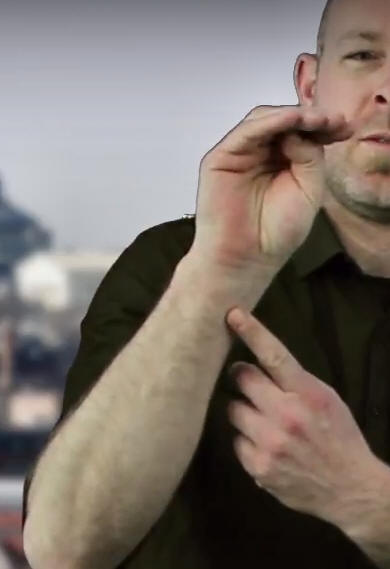
Research Note:
While the letter "M" is typically shown in textbooks and/or
fingerspelling charts as three fingers draped over the thumb -- in real
life, everyday use you will also occasionally see the letter "M" appear
as 4 fingers only slightly curved and pointing forward (at a comfortable
angle) with the thumb tucked underneath. Also, when spelling long,
unusual, or complex words in ASL it is common (but not required) to use
the index finger of the non-dominant hand to point to or touch the wrist
of the dominant hand. (Graphic source: Malzkuhn,
Matthew, 2018, https://youtu.be/7EORESKGdAI?t=16 Promotional Video, Deaf
Studies Conference, Transformations, 2018, Gallaudet University,
Retrieved, 9/11/2028 from
https://my.gallaudet.edu/2018-deaf-studies-conference).
Question: What should you do when you need to fingerspell
hyphenated words? Should you draw the hyphen?
Response: If it is important to the message, then include the
hyphen in your fingerspelling by drawing a small dash.