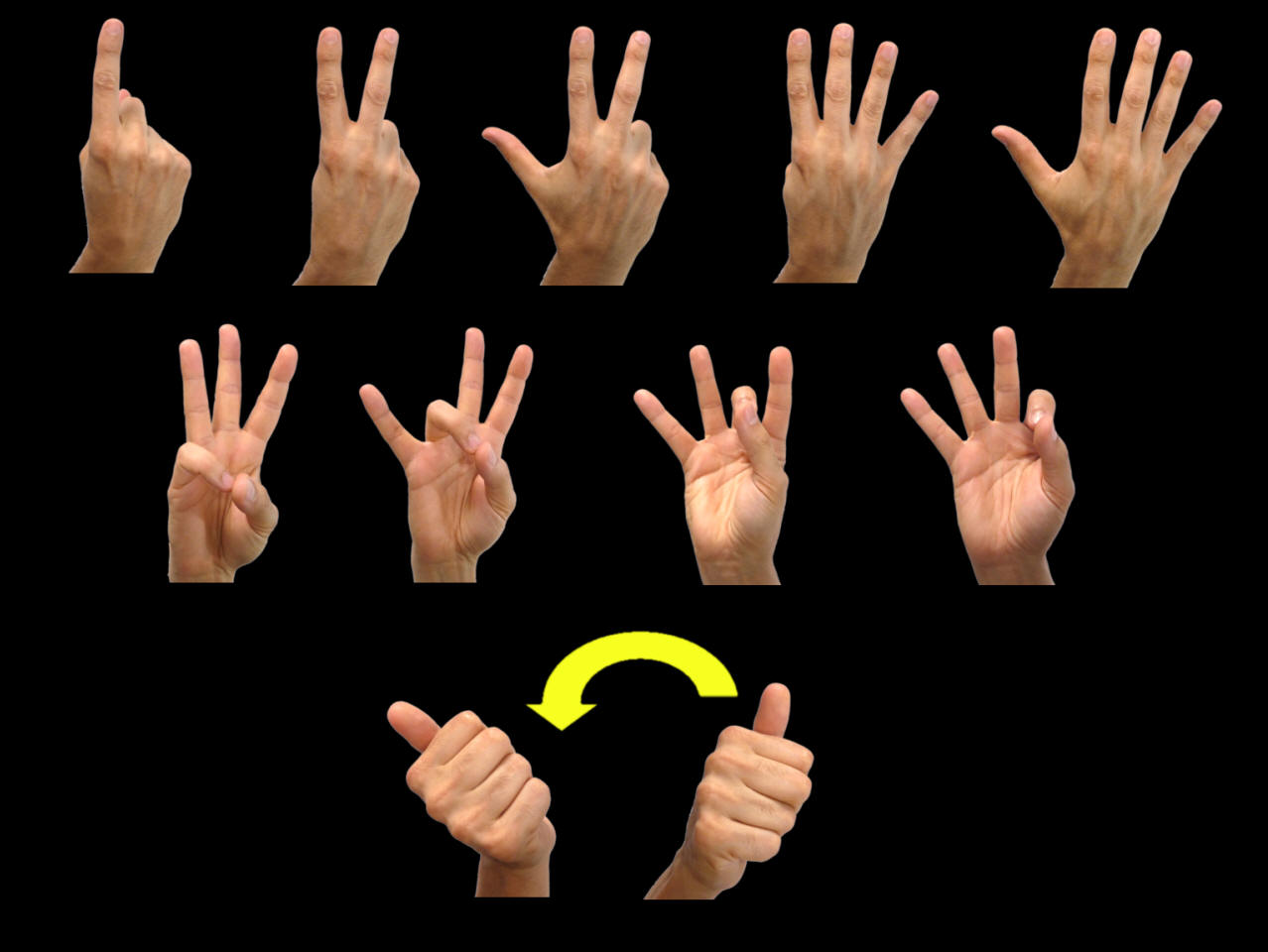
LINKS: Numbers 1-10 / 11-20 / 21-30 / 31-40 / 100-900 / 1000 and up / Fractions / Numbers Chart
Notes:
Question:
A student asked: "I had learned the numbers for the 20s using the 2 handshape in my ASL class here in Miami (with the exception of 20, 21, and 25). Is the L handshape preferable universally, or might this just be a localized variation?"
Answer:
When discussing versions of signs that may or may not be more common than other versions of signs -- rather than using the word "universally" perhaps we might be safer using the words "on a wide scale" or "more reflective of the signing done in general
by the ASL signing Deaf community." An ASL student would do well to learn both the "L" version of the 20's as well as the "V" version of the 20's.
My opinion after having lived on both coasts and other places (Oregon, Washington DC, Utah, Texas, Indiana, and California) is that the "L" version is more commonly used by native Deaf adult signers who are socially active in the Deaf Community and
view online Deaf media. Does that mean the "V" version of the 20's is wrong or that a person couldn't go online and find a hundred examples of the "V" version of the 20's? If you look hard enough you can generally find examples of almost anything
out there signed by someone. The "V" version isn't wrong. Quite a few people do use it. However, it has been my experience that most skilled Deaf signers in general lean toward the L version of the 20's.
For example, see "24" at Handspeak: https://www.handspeak.com/word/search/index.php?id=3369
and/or Spread the sign: https://media.spreadthesign.com/video/mp4/13/109480.mp4
Those are not just random sites but rather they are dictionaries that are well-respected in the Deaf community and considered by many to be highly authoritative in terms of being reflective of the type of signing done by Deaf people who use sign as
their main form of in-person interactive communication.
If you have not yet done so, I encourage you to watch this instructional video regarding ASL numbers:
https://youtu.be/CcGIPShq34g
Notes: