DAY: The
American Sign Language (ASL) sign for "day"
DAY (version 1)
 The sign for "day" is made by holding your
non-dominant arm (the left arm for most people) in
front of you, palm down, pointing right. Your non-dominant hand can be in either a
"flat handshape" or an "index finger handshape." Your dominant hand (the right hand for most people) can be either
an "index finger" or a "flat hand." (I don't recommend a "D"
hand, that is Signed English.) Rest your dominant elbow on
the back of the non-dominant hand. Your dominant arm should point up. Move your
dominant arm
across your body, the hand tracing an arc while keeping the dominant elbow on or
very near the back of the non-dominant hand.
Note: advanced signers often do very abbreviated versions of signs. For
example, they may do the sign for day with the tips of the fingers of
non-dominant hand
touching the midpoint of the dominant forearm instead of resting the dominant elbow on
the back of the non-dominant hand. Also, you might see a different palm orientation on
the dominant hand.
The sign for "day" is made by holding your
non-dominant arm (the left arm for most people) in
front of you, palm down, pointing right. Your non-dominant hand can be in either a
"flat handshape" or an "index finger handshape." Your dominant hand (the right hand for most people) can be either
an "index finger" or a "flat hand." (I don't recommend a "D"
hand, that is Signed English.) Rest your dominant elbow on
the back of the non-dominant hand. Your dominant arm should point up. Move your
dominant arm
across your body, the hand tracing an arc while keeping the dominant elbow on or
very near the back of the non-dominant hand.
Note: advanced signers often do very abbreviated versions of signs. For
example, they may do the sign for day with the tips of the fingers of
non-dominant hand
touching the midpoint of the dominant forearm instead of resting the dominant elbow on
the back of the non-dominant hand. Also, you might see a different palm orientation on
the dominant hand.
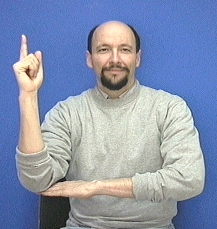



If you see the movement start horizontal and move upward it is not wrong.
Lots of people do the sign that way:
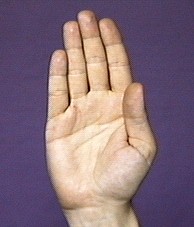 Note:
Note:
When signing "DAY" you can use a "flat hand" (which is also sometimes called a
"b-palm") instead of an index finger.
DAY (flat hand version)

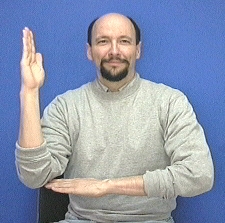


Sample sentence: "One week has how many days?"
Notes:
There are many variations for the sign "DAY." For example: "ALL-DAY"
To sign "all-day," start the flat-handed version of DAY with your dominant
"flat hand" further to the right (if you are right handed) prior to
moving it.

For an example of "all-DAY" and other variations of DAY,
see: "DAY (advanced
discussion)"
Notes:
Also see: TODAY
Discussion:
Question: A student asks: "I was taught to do day with a D, and
then the movement you do, is that wrong?"
Response:
Using the "D" hand for a sign like "day" is considered (by many) to be more
toward "signed English" than "ASL."
Using the "D" hand for "DAY" is a minor signed English intrusion if / when you
are attempting to sign ASL.
You might even occasionally see Deaf signers use the "D" hand but most of us in
everyday life tend to use the index finger for "day."
Of possible interest, for the sign "all-DAY" we use a flat hand and a bit larger
movement.
You may wish to think of the situation as whether you'd rather have a Deaf (or
"fluent ASL) signing accent or a Hearing (Signed English) signing accent. If you
want to sign more like a native / fluent Deaf person, use a '1" hand instead of
the "D" hand.
https://youtu.be/rs0p2SmjyjA
Notes:
Where this sign is taught:
Taught in Lesson 12.Reviewed in lessons: 14, 41, 43
Practice sentences using this sign:
ONE DAY EQUAL HOW-MANY HOUR? (How-many hours are in a day?)ONE MONTH EQUAL HOW-MANY DAY? (How-many days are in a month?)
ONE WEEK HAVE HOW-MANY DAYS? (How many days are in a week?)
YOU SCHOOL WHICH DAY? (Which days are you in school?)
PEOPLE GO CHURCH, WHICH DAY? (On which day do people go to church.)
WORK YOU? SICK DAY VACATION YOU CAN HOW-MANY? (Do you work? How many days of sick-leave do you get?)
HALLOWEEN, WHAT DAY?
MEMORIAL-DAY HOLIDAY WHAT DAY?
COLUMBUS DAY WHEN?