Recommendation:
Avoid signing the concept at all.
Instead adjust your sentence or discussion to be about Deaf people rather
than a medical condition.
If you "must" for some reason sign the concept of "deafness" here
are a few ways to go about it:
Version 1: [context] + the sign DEAF
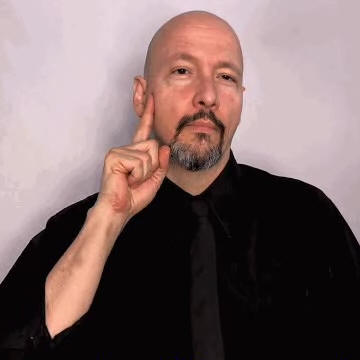
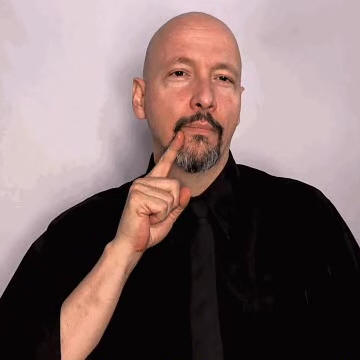
Version 2:
Fingerspell it:
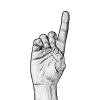
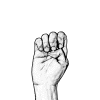
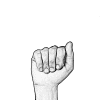
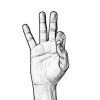
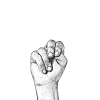
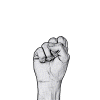
Version 3:
Sign DEAF and spell N-E-S-S
Warning to those of you who only look at pictures and don't read. WAKE UP and read if you go any further:
Some of you are or will become interpreters for the Deaf.
As such if you become a working interpreter for the Deaf and go out into the
Deaf World you will very likely eventually see someone use the Signed English
sign for "deafness." I'm assuming here you would rather recognize it than
have to interrupt and ask what it means.
Such being the case I'm going to show you the Signed English version of the
sign.
Some of you are going to be an "idiot" and run to your ASL instructor or Deaf
friend and say that "Dr. Bill" of ASLU / Lifeprint says the sign for "deafness"
is [__________]" and then you will show them the following sign without context
or explaining that the only reason I'm showing you is so that you can add it to
your receptive vocabulary.
Since the above notice is too complex for some of you I'm going to put this
clearly:
I'm showing you the Signed English version of the sign so you will RECOGNIZE it
-- NOT so you will start signing it.
Understand it if you see it -- but don't sign it.
DEAFNESS [Signed English version] [not recommended]
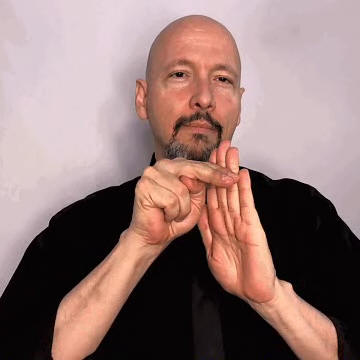
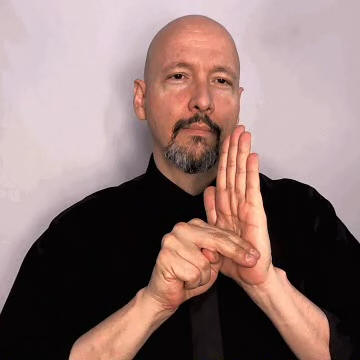
Animated gif: DEAFNESS:
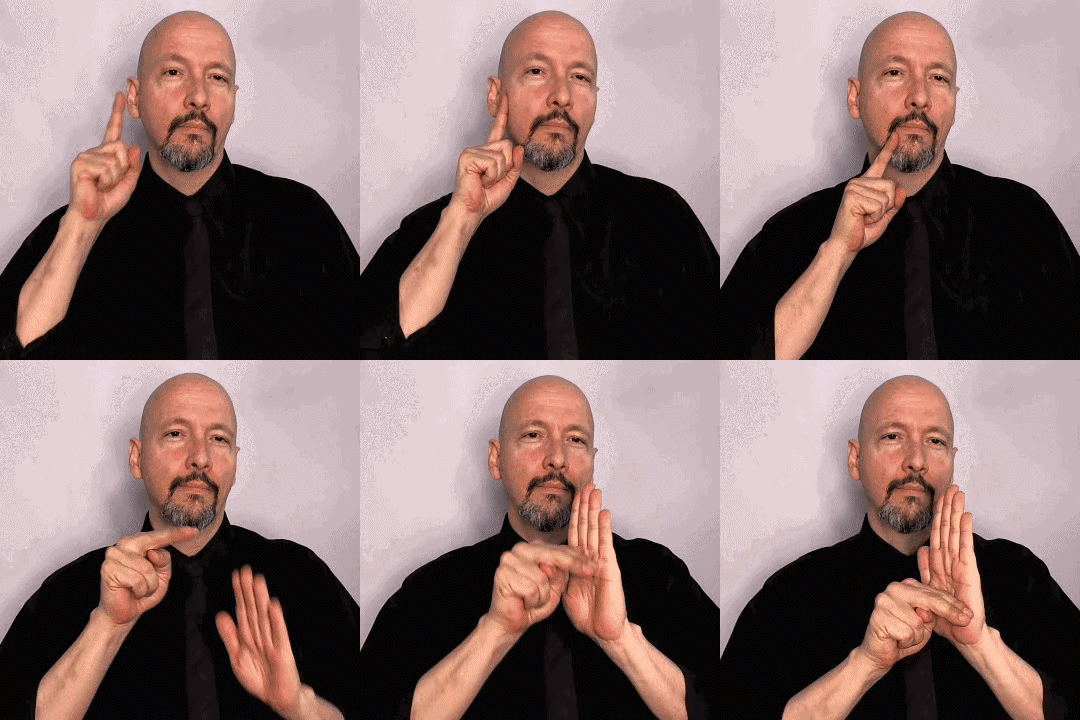
Remember the above version using the "NESS" suffix is:
(Got it?)
Notes:
Most "culturally Deaf" leaders
and authors have negative views regarding the use of the word
"deafness."
Most of us prefer to simply avoid the phrase and use some other way to discuss
the state of being deaf.
Some examples:
"... Deaf..."
"... people who are Deaf,"
"... Deaf and hard of hearing people..."
"... since becoming deaf she..."
"... being deaf..."
"... her being deaf did not prevent..."
"... the fact that she is deaf had little bearing on..."
Some authors use the phrases "... not hearing..." or "individuals with hearing loss."
While that is better than the (unacceptable) term "hearing impaired"
it focuses on loss rather than gain. Instead it is recommended that you
simply use the term "Deaf" or if you you have some strong reason to indicate the
state of being physically deaf (such as writing a dissertation comparing the
outcomes of children born deaf into (culturally) Deaf and Hearing households)
then use the lowercase term "deaf." Be advised though that there are those who
feel that the word "Deaf" should always be capitalized. A dictionary entry
is not the place to deep dive into a topic deserving of a nuanced chapter in a
book. Such being the case, readers are encouraged to go read several "Deaf
Culture" books or view numerous vlogs (preferably written or signed by
culturally Deaf individuals).
See: DEAFHOOD
Notes: