Tip: Along with reading this page you might want to consider also
reading: Colonization
via Euphemization
The right sign for "foster" depends on your intended meaning and the situation
in which you are signing it.
ENCOURAGE:
If you mean "foster" as in "encourage," see:
ENCOURAGE
SUPPORT: If you mean "foster" as in support, If you mean "foster" as in
"encourage," see: SUPPORT
FOSTER-PARENTS
Suggested approach: Spell foster and then sign "mom" and "dad."
FOSTER-(fs) + PARENTS
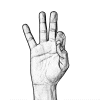
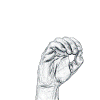




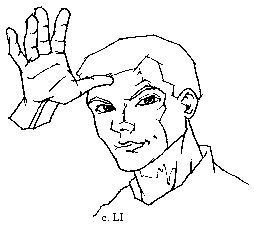
In addition to the suggested approach to signing "foster parents" (above),
interpreters and ASL instructors are also encouraged to be familiar with
alternative or legacy versions of the sign so as to be adaptable and aware of
historical or newer approaches to signing "foster parents."
Recognition vocabulary: Be able to recognize and interpret the meaning of
the following signs when done in context:
FALSE + PARENTS-(version of "foster parents")
Notes:
For many years it was (and as of 2023 still is) common in the (American) Deaf Community to sign "foster parents" by
combining the sign listed in ASL many dictionaries as "FALSE" with the sign "PARENTS."
That approach may seem "harsh" to Hearing second language learners
of ASL -- but the fact is that is how the concept of "foster parents" has been
signed by a great many Deaf people for a great many years. It isn't meant
to be an insult. If you think of the sign FALSE / FOSTER as a homonym
consisting of two different words that happen to share the same sign it
might make it easier to understand.
"foster parents" (alternate version)
TEMPORARY + PARENTS
"foster parents" (alternate version)
TAKE-CARE-OF + PARENTS
"foster care" (recommended version)
FOSTER-(fs) + TAKE-CARE-OF
Recognition vocabulary:
Interpreters should be able to recognize the legacy version of "foster care"
signed by some Deaf people by using the signs FALSE + TAKE-CARE-OF
FALSE + CARE-(version of "foster care")
FALSE:
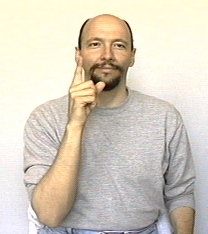
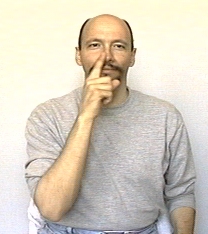
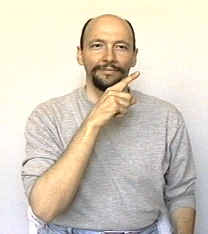
To do the sign for "false," move your "Index finger"
quickly
past your nose. Your index finger doesn't touch the nose, it just
comes close.
Your index finger doesn't touch the nose, it just comes close. The movement
can be in the wrist or it can be more in the elbow as I show here. The
movement is NOT in the knuckle. Sample sentence: TRUE FALSE
TESTS, YOU LIKE YOU? (Do you like true/false tests?)
Regarding using the sign commonly glossed as FALSE to mean "foster"
-- the discomfort felt by some people is likely based on an overly narrow
association of the signs meanings with the main English-based gloss of the sign.
However, if you think of the sign as meaning "not actual" (not the birth
parents) and stop limiting your mental interpretation of the sign to a subset of
meanings of the English word commonly used as its gloss -- the sign no longer
carries a negative feeling when used in contexts discussing foster parents.
For many, many years the sign "FOSTER-PARENT" has been used in the Deaf
community without outward indication of an internal mental sense of negativity.
In other words -- that was just the sign. It was not (and should not be) signed
with some sort of negative facial expression.
Thus the problem here may not be that the sign FALSE is being used to mean
"foster" but rather that the English word "false" has been stuck like a
restrictive straightjacket over the ASL sign.
Notes:
In regard to the signing of FOSTER-PARENTS:
Language changes. My advice next week might be different but my current advice
to ASL educators, interpreters, students, or linguists:
1. Spell "foster" (in the concept of "foster parents") when signing to an
unknown or mixed audience.
(Am I happy about that approach? My "feelings" don't matter in this situation.
For my views, see my article "Colonization Via Euphemization."
The community decides. I don't get to decide what does and doesn't become
standard in ASL. "You" don't either. After a new norm has been established then
that is the new norm. At that point what you get to decide is whether you want
your signing to be understood by the widest possible audience. If so, then sign
using the most commonly recognized form of a sign. If you want to evangelize
that is your choice but there is a tradeoff in recognition and an increased
potential for misunderstandings.)
2. Develop the skill of recognizing multiple versions of FOSTER-PARENTS
including but not limited to the use of signs typically glossed as FALSE,
SHORT-(duration), and TAKE-CARE-OF.
3. If you are an interpreter and your Deaf client uses a particular sign for
"FOSTER" in the concept of "foster-parents" then strive to use that sign for the
duration of the interpreting assignment.
4. If asked what the sign for "foster" is or should be -- defer to the opinions
of culturally-Deaf signers who use sign-language as their primary mode of
face-to-face daily communication.
5. Embrace the idea that signs mean what the Deaf Community decides they mean --
not what authors label the signs as in dictionaries and textbooks.
6. If a Hearing person or fellow interpreter tells you they don't like to sign
FALSE-PARENT to mean "foster parent" -- consider the situation, your role,
and/or your relationship -- then if appropriate you may choose to engage them in
a discussion in which you point out that if we get beyond the knee-jerk level
and analyze the signs linguistically -- ASL doesn't sign FALSE to mean foster
parent. Facial expressions and context matter. Basing the interpretation of a
sign on anything less than the full set of parameters* and pragmatics** of a
sign is inappropriate.
* The full set of parameters needs to include facial expressions (non-manual
markers) in addition to such things as handshape, location, orientation, and
movement.
** Pragmatics is the study of how context contributes to meaning.
Also see: FALSE
Also see: PARENTS
Discussion:
A foster parent (who may or may not be named Eric) writes:
On Thursday, November 9, 2023 at 01:45:13 PM PST, Eric ███████
<███████████@gmail.com>
wrote:
Hi, Dr. Bill,
I'm a hearing foster parent currently caring for three deaf babies (and trying
to get up to speed with ASL ASAP!). Your discussion about the usage of foster
(the FALSE + PARENT version) was very helpful for me to understand. My gut
feeling the first time I saw the sign was to relate it to negative connotations
in English, generally, and from the Bible, more specifically. Also, no parent
(foster or not) wants to hear from their kid "You're not really my parent!" even
if it's a factually true statement. It's helpful understanding that it's not
signed with any negative connotations, and that the sign for foster indicating a
"not actual" parent is not an act of rebellion or distaste.
Something else this discussion reminded me of (especially in your expansion in
Colonization via
Euphemization) is that much English is made up of a lot of foreign words
smashed together with little care for the exact connotations of the original
words. It helps that ancient Greek and Latin aren't in usage anymore for people
to complain!
Thanks again!
Eric █
Reply from William Vicars, Ed.D:
Eric,
I "do" understand the drive or desire to self-define using strong-positive
words.
Words (and signs) are like containers that we pour our thoughts into and if the
container has a "negative" shape (aspect, influence, etc.) it shapes our
feelings and emotions regarding ourselves or those to whom we have applied the
words.
I'm glad though for your email because I'm giving a workshop Monday and I was
wracking my brain for examples of homonyms in ASL and the sign that is used for
FALSE, FOSTER, ARTIFICIAL, etc. is a homonym (in ASL). Or rather "FALSE and
ARTIFICIAL -- in ASL are a polyseme and the "FOSTER" aspect of the sign breaks
the meaning far enough away that we could argue it is a homonym -- same form /
different meaning (to the extent that it is truly a different sign in terms of
meaning). Note: I don't expect the word polyseme to mean anything to people
unless they have studied that aspect of linguistics but that isn't important.
I'm just saying that FOSTER and FALSE are well and truly different "signs" in
ASL that just happen to look the same and share an etymology.
...
Warm regards,
+ Bill
________________________
William G. Vicars, Ed.D.
Notes: