MOOD: The
American Sign Language (ASL) sign for "mood / moody"
The concept of mood / moody is typically spelled in ASL.
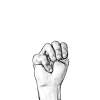
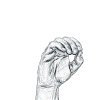
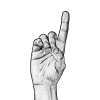
The concept of "mood" is occasionally expressed via lexicalized spelling in the
form of "M-slide/become-D."
FEEL is sometimes used to mean "mood." A person might sign IX-me
BAD FEEL-(annoyed facial expression) to mean "I'm in a bad mood."
ATTITUDE is sometimes used to mean "mood."
Some people sign "mood" by patting the dominant-side cheek with the flat (palm side) of the fingers of a flat-hand (or just a relaxed hand).
https://youtu.be/z-Pk8UT8qOg?t=210
Usage note: The "flat-hand pats cheek" version of mood is somewhat uncommon and seems to lean toward the concept of "in a mood," "bad mood," or "moody." I recommend you only use it if the Deaf in your area use it. When in doubt – fingerspell "mood" or "moody."
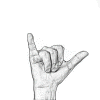
MOODY:
The concept of "moody" is sometimes expressed by signing "GROUCHY" which is a
double movement / less intense version of MAD.
Notes:
Question: Do you think that the cheek-based version of MOOD is
related to the sign for "period" as in "MENSTRUAL
PERIOD"?
Response: I suppose it is possible (but I have seen no evidence)
that people may have at one time signed an "M" on the cheek as an initialization
to mean "mood" based on an potential association with the sign MENSTRUAL PERIOD.
If so it would be plausible that over time the "M" handshape relaxed into a bent
hand and eventually a flat hand. That however is conjecture and I'd
welcome submission of video evidence from as early as possible of any video
recordings of the sign "MOOD from the early days. Such an evolution of the
sign from an M to a bent hand occurred with the sign for "doctor." When I
tell people that "DOCTOR" used to be signed with an "M" hand they argue with me
until I show them documentation of it in early ASL dictionaries.
I note that I see at least one popular young lady on YouTube uses a sign that
looks remotely like TOBACCO (or maybe a very, very relaxed cheek based version
of the sign for KNOW) to mean mood. If I saw that on an expressive ASL exam I'd
probably take off some points. (Small differences in articulation of signs can
change the meaning). However, the fact that some versions of MOOD involve a bent
hand lends credence to the idea that possibly at one time the handshape might
have been an "M."
==================
As always, language is a moving target.
I encourage my students to sign the way they see adult, socially active, local
Deaf skilled signers sign.
(That requires getting to know local socially active, adult Deaf skilled
signers.)
Notes: