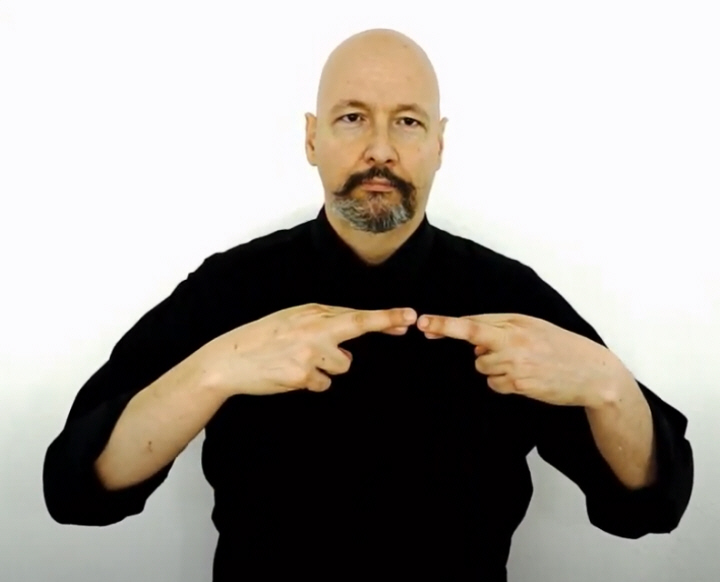
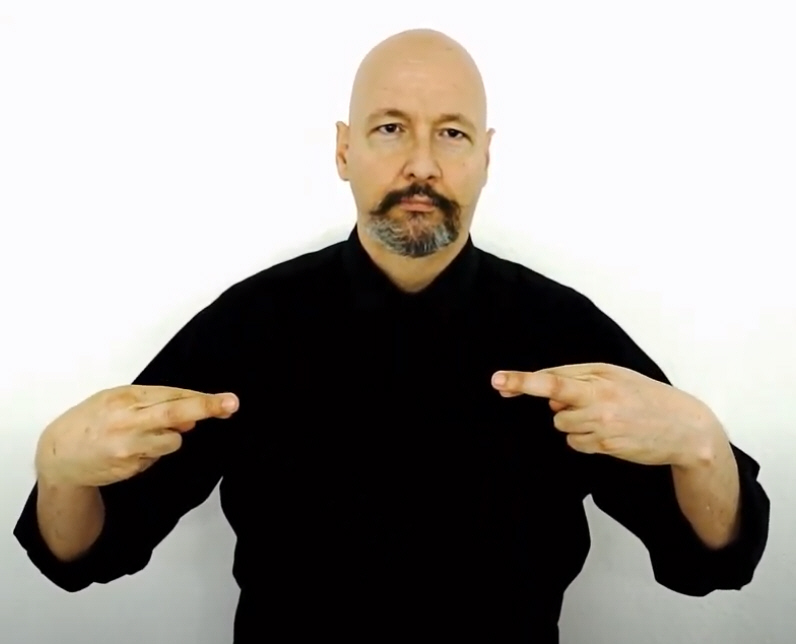
A common sign for rope is to hold up two "R" hands pointing at
each other (touching or almost touching) and then pull them apart.
QUESTION: A student asks:
"Is the sign ROPE initialized or is it just a classifier?"
Answer:
ROPE is three things:
1. An initialized sign in which handshape of the sign consists of a
fingerspelled letter that matches the initial (first) letter of the spelled form
of a generally corresponding concept in an other language. For example,
the handshape used in the common sign ROPE is an "R" in the ASL alphabet and
that "R" matches the letter "r" of the word "rope" in English.
(and)
2. A (lexicalized) classifier that has fossilized such that it can be used as a
regular sign representing a general concept but not conveying extra meaning.
We can sign ROPE to refer to "rope" in general without implying (or denoting)
the meaning of "twisted" nor does our usage of the sign imply thickness, length,
internal structure, arrangement or other characteristics of the rope. For
example, we can sign "RUBBER ROPE" to refer to a type of rope that is unbraided.
In such references the R handshape actually conflicts with the concept being
expressed (an unbraided, solid-core rope) and thus is not depictive -- yet we
still use the "R"-hands sign for ROPE because it has fossilized into a
representation for the generic concept of rope and (in some cases) doesn't map
to the shape of the (non-braided) rope and isn't being used to add additional
meaning to the generic concept of rope.
(and)
3. A classifier capable of depicting characteristics such as location, internal
structure. With sufficient context we can change the way in which we sign
(or "inflect") the sign ROPE to convey specific meanings beyond simply the
generic meaning of rope. For example we could hold up a non-dominant V and
then use the dominant hand to "twist" the V into an R and then add a second R
and sign rope to create the specific meaning of "twisted strand" rope.
Another example is we could start the sign ROPE at the non-dominant side of our
signing area near the body and then extend the dominant hand outward, then to
the dominant side, and then back toward the body to use the sign ROPE as a
classifier indicating a "roped off square area.
Rope can be signed via several other classifier-based ways approaches that can
themselves be considered frozen classifiers but unfrozen as needed to create
other meanings.
For example "i" hands can be used to mean a string or rope and then further used
to refer to a very thin rope, a finish line, or a bracelet snaking around one's
wrist. The use of "i" hands in this situation is not mapped to an English word
and thus would not be considered an initialized concept. If signed out of
context the "i" hands version of rope tends to mean things such as boundary,
line, thread or string. Thus context is necessary for "i" hands to mean
"rope."
F" hands can be used to represent (or depict) the size, location, arangement,
and (to some extent) the length of a rope. However such depiction is "not" a
regular sign and will generally require significant context so as to distinguish
that you are not talking about a pole, branch, diploma or any other thing with a
fairly small, round, elongated shape.
"C" hands can be used to depict thick or large ropes. Context is necessary in the use of "C" hands in regard to representing the concept of a rope.
"Index fingers" can be used to represent ropes. Again, context is necessary
in the use of "index fingers" in regard to representing the concept of a rope.
Consider the fact that index fingers, "i" hands, "F" hands, and "C" hands
require context to mean rope but the "R" hand version of rope does not require
context and simply defaults to meaning "rope."
Consider the fact that "i" hands when held in front of the body (with the pinkie tips pointed toward each other) and moved apart can (depending on context) mean rope, boundary, line, a chain, a string, and other concepts but the "R" hands when held in front of the body (with the R's pointed at each other) typically default to the meaning of "rope" in the mind of the observer. In other words, when someone sees you sign ROPE they generally map it in their minds to the concept of "rope." When someone sees you sign "LINE, boundary, string, ...) their mind goes into a wait and see mode as it tries to decide what concept you are discussing.
It is perhaps interesting to consider the use of "C" hands to sign CABLE-(a
great big thick one)
It might be tempting to think of the "CABLE"-("C" hands sign) as an initialized
sign because the letter "C" maps to the first letter of the word "cable" but we
first need to consider what is the default association that occurs in the mind
of native skilled Deaf Adult ASL signers when they first see the "C"-hands
moving apart in front of the body sign? If the association is generally
"not" instantly the word "cable" then we could state that this sign is "not" an
initialized form of rope but rather it is a classifier representing round
elongated things that are (generally) not skinny, tend to be about eight
centimeters in diameter, but could be much larger depending on context.
Notes:
index-old.htm
matrix-for-sign-pages (_matrix.htm)
Notes: