In general, just point at the specific object if it is in the area or
point downward using a relatively small, quick movement.
THIS:
Also see: INDEXING
THIS as in "this
morning"
While some people may sign THIS + MORNING to mean "this morning" another
approach is use the NOW sign (which means current, at this time, and similar
concepts).
Notes:
A student asks:
What is the difference between THIS and the second version of HERE that
points at the ground?
Response:
The one-handed version of HERE-[version-2]-[index-finger-handshape]
looks and moves very much like the one-handed sign for THIS.
Distinctions can include HERE-[version-2] will often tend to use a
slight double movement. THIS will often be used to mean IT and point at
an object if the object is in the signing space. Also, THIS sometimes
will (rarely and not recommended -- but it can) use the non-dominant
palm-up flat hand as a base for the dominant index finger.
The above distinctions aside, the two signs are the same.
A student asks:
Is the sign for "this" the same as the letter "Q"? I can't see any
difference between the two. Thank you.
Response:
That is a great question. The movement of the sign for "THIS" tends to move
downward a bit whereas the movement of the letter Q tends to consist of simply
moving your hand to the neutral space used for fingerspelling (if your hand isn't
already at the neutral fingerspelling location). In fingerspelling there is usually no additional movement of a
"Q" however you can circle the Q a bit to indicate that it is being used as an
"initial."
The handshape for the sign "THIS" is generally a "1"-handshape but will vary a
bit depending on the angle of the wrist.
Many people might not believe that the handshape for "THIS" is somewhat
variable. Some people may insist that the handshape is (or should be)
always like that of the number 1. In other words they will tell you the
(so called) "right" handshape for "THIS" is a typical index-finger pointing
handshape (with the index finger straight, and the thumb curved or wrapped over
to and touching the middle finger.
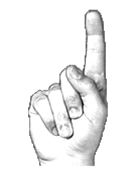
However, for those people who are open minded and would like to explore this a
bit, when lying on your back (on couch or bed) and you sign "THIS" (pointing
physically downward -- not at your feet but at the floor beneath you) the
handshape tends to mutate toward being somewhat like a "Q" (or "G") -- not a typical pointing index
"index finger." Sometimes the "Q" handshape will occur even when standing
up and doing the sign "THIS" fairly close to the body and pointing downward.
The handshape is influenced by the tendons in the wrist. To experience
this for yourself, form an INDEX
finger "1" handshape then bend your wrist forward as far as you can and watch/feel
what happens to your thumb.
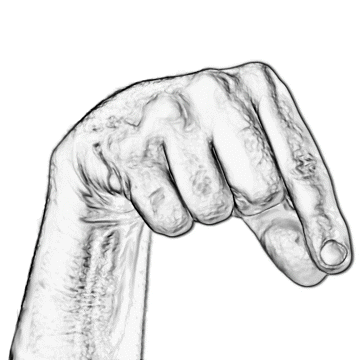
Another example of the change in the "1"-handshape is when a person signs "ME."
We generally think we are using a "1" handshape, but often due to the angle of
the wrist, we end up using a version of a "G" handshape."
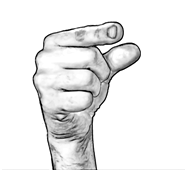
It seems that a "1"-hand (pointing finger) just naturally tends to turn into a
"Q" or "G" handshape when the wrist is bent. The extent to which this
happens is influenced by the individual signer's flexibility of tendons and
ligaments in the hand and wrist as well as if they are consciously thinking
about it.
If you ask a person how to sign ME or THIS -- the person becomes very conscious
of what their hand is doing and consciously forms a "1"-handshape with the thumb
bent across and touching the middle finger. If you were to video record
that person doing those signs at high speed (using a high resolution camera with
a high shutter speed, high frame rate, and good lighting) chances are you will
see a more relaxed-thumb handshape such as a "G" or "Q" show up.
So, again, an interesting note about the signs HERE-(one-handed-pointing-downward_version),
ME, and THIS is that most signers "think" the handshape is a typical
"1"-handshape finger but what often happens during casual, high-speed signing is
that as the signer bends their wrist to point downward
the index finger turns into a downward pointing "G" hand due to the
tendons in the wrist pulling on the thumb. Of course this handshape
change (or not) varies from person to person depending on the
flexibility of their hands.
I recommend you in general aim to use the "1"-handshape for HERE-(one-handed-pointing-downward_version),
ME, and THIS but relax and don't worry about it much if you end up doing a "G"
or "Q" handed version. If you have a local ASL teacher who corrects you on
it -- smile and do your best to do it the way they want until you get the grade
you want -- after which, if you feel the need to, consider watching a few of
their videos and catching them signing one of those signs when they aren't
consciously thinking about their handshapes and sending them a clip of a video
of them doing the same thing they criticized you for doing. I'm sure it
will endear you to them and they will want to write you letters of recommend for
being so astute.
Question:
A student writes: "My teacher taught us to use our right index
finger and lay our left hand out open and point to the middle for the
sign "this"."
Response:
We can categorize the
2-handed version of THIS (in which you point at the palm-up palm of the
non-dominant hand) as a low-context, non-specific citation version.
In other words, if you don't have anything specific to point at then you can
whip out your non-dominant hand and point at it.
Using a low-context, non-specific, citation version of a sign in a high-context
circumstance can indicate a lack of signing competence.
In other words, it would be odd to point at your hand to sign THIS if the item,
thing, or person to which or whom you are referring can be pointed to in real
life.
I'm not at all saying the low-context version of THIS is incorrect. Every
skilled signer (particularly ASL teachers and interpreters who earn money for
signing) should know and be aware of that version.
The challenge or issue is that often ASL teachers teach a beginner using
phraseology such as:
This is "the" sign for ______ (insert concept here)."
A more appropriate phraseology would be:
This is "a" sign for _______ (insert concept here)."
or
One of the signs for _______ (insert concept here) is [demonstrate or describe
the sign here].
Notes:
Keywords: phoneme, phonemes, phonology, articulation, tendons, ligament,
ligaments, physical constraints, ...
Also see: ME
Notes:
Where this sign is taught:
Taught in Lesson 01.Reviewed in lessons: 08, 13, 18, 20, 23, 30, 31, 33, 40
Practice sentences using this sign:
THIS THEIRS-singular? [point at any object] ([point at any object] (Is this hers, his, theirs?)THIS ROOM HAVE GLASSES WHO? (Who in this room has glasses?)
YOU THINK THIS CLASS HARD? (Do you think this class is hard?)
PAST TEST THIS CLASS YOU WRONG how-MANY? (How many did you miss on the previous test you took in this class?)
YOU THINK THIS CLASS EASY? (Do you think this class is easy?)
YOU LEAVE-[go-away] THIS CLASS, what-TIME? (What time will you leave this class?)
GIRL THIS CLASS STRAIGHT-HAIR, HOW-MANY? (How many girls in this class have straight hair?)
THIS CITY, BOOKSTORE, HOW-MANY?
THIS BUILDING HAVE ELEVATOR?
THIS BUILDING, FLOORS, HOW-MANY?
... and 10 more practice sentences use this sign.