Coarticulation
Coarticulation has traditionally been spelled
using a hyphen. For example, "co-articulation." It is common however for hyphenated words to lose their
hyphen over time and with usage. For example "electronic mail" became E-mail,
then e-mail, and eventually--in-context--just "mail."
Perhaps someday
"coarticulation" will eventually become "coart." For now
let's use the
term "coarticulation" and if necessary assure our spell checkers
that it is okay and to "not worry" about it.
Coarticulation is commonly defined as "the articulation of two or more speech
sounds together, so that one influences the other." (Source: Coarticulation,
Oxford Dictionary of English, 2010)
As a memory aid, think of coarticulation as being
what happens when a combination of letter
handshapes are articulated (fingerspelled / produced / signed).
Coarticulation, in regard to visual languages (such as American
Sign Language) refers to the process of signing (articulating) two or more sign
segments either simultaneously or sequentially.
When we study coarticulation we tend to look for how sign segments influence
each other during signing. The changes that take place resulting from
coarticulation are referred to as "coarticulatory effects."
When we discuss coarticulation effects it is easy to focus on handshapes but other sign parameters
(movement, location, palm orientation, and other caracteristics) can be and are
affected by coarticulation effects
.
Sign segments generally consist of one or both hands being formed
into a particular handshape and then one ore more of the following:
1. held in a particular location and orientation
2. moved from a location to another location.
3. changed from one orientation to another
4. changed from one orientation to another while moving to a new location.
We can extract some consistent characteristics out of such sign segments including:
1. handshape
2. movement (including many sub-categories such as speed, path, force, acceleration, deceleration, etc.)
3. holds
4. orientation
5. location or path (Think of a path as movement along a sequential series of locations.)
"Coarticulation of Fingerspelled Letters in American Sign Language"
The American Sign Language alphabet generally consists of 22 handshapes* that--when held in specific positions and/or are produced with
specific movements -- represent the letters of the American alphabet.
However, when we fingerspell letters together it is common for individual
letters to be influenced by the letters that are being spelled before and after. We are
"articulating" (doing) a letter combination each time we spell a word. Letters
that are combined and spelled (articulated / signed / done) often look quite
different than letters done in isolation.
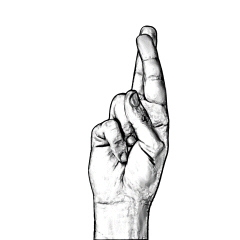
For example if you hold up an isolated (done alone) "R"-hand the isolated "R"
tends to look different than an "R" that has been coarticulated (combined into a
word with other letters) in the fingerspelled word "C-A-R."
A "citation" or "standard" R-handshape:
An "R-handshape" that has been coarticulated with the letters "C" and "A" in the
fingerspelled word CAR:
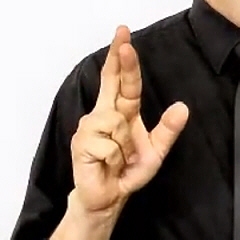
CAR-[fingerspelled-version]
* Note: While typical fingerspelling charts only show 22 different handshapes (with duplicates for G/Q, I/J, and K/P), there are in fact many more than just 22 handshapes used in fingerspelling when you consider the variety of shapes that occur when letters are coarticulated.
Let's play a little word game.
I'll give you the definition of a word and you tell me what the word is.
Warning:
Most people can't figure it out.
According to the (Oxford) Dictionary this word means:
1. Having joints or jointed segments.
2. The ability to speak fluently and coherently.
3. "Using language easily and fluently; having facility with words."
4. "Expressed, formulated, or presented with clarity and effectiveness."
5. This word also means: "Made clear, distinct, and precise in relation to other
parts."
* The mystery word is …
"Articulate"
Example:
"Bee is an articulate signer."
Example:
"Bee is very articulate."
Example:
"Bee knows how to articulate her ideas well."
So, obviously the word "articulate" has many different meanings.
How are WE going to use articulate today?!?
How will we use the word "ARTICULATE" in this lesson?
Articulate means to "sign something."
Articulate means...
To do a sign.
Produce a sign.
Express a sign.
To move our stubby little fingers around in the air and form various handshapes
in particular locations, following certain paths, at various angles of
orientation.
Articulate for me the sign CAT.
BRAVO!
The sign CAT is a bundle of articulatory information:
handshape
location
orientation
movements
and holds
We are not going to discuss nonmanual markers (NMM) right now -- but NMMs are
often part of articulatory bundles.
The articulatory bundle known as the sign "CAT" consists of a sequence of
handshapes, locations, orientations, holds, & movements.
A sign is an articulatory bundle of what?
Handshapes,
locations,
orientations,
movements,
holds,
(and NMM's).
Let's adjust that a bit.
A sign is an articulatory bundle of handshapes, locations, and orientations that
are expressed in a sequence of holds, and movements.
What does the word "sequence" mean?
The word "sequence" means "a particular order."
What is the difference between a part and a segment?
Segments have zones of demarcation.
Let me put it this way…
You can eat part of an orange.
You can eat an orange segment.
You can drink some of a glass of water
You can't drink a segment of water.
Oranges have segments. Water doesn't.
Signs are not amorphous blobs.
Signs are composed of segments.
What does the prefix "co-" mean?
The prefix "co-" means "with."
Co-articulation is to do one sign with another sign
simultaneously
or
sequentially
Coarticulation is the signing of more than one sign either simultaneously or
sequentially.
Sign BROTHER
Sign SISTER
Sign: "brother and sister"
Sign: "TIME"
Sign: "We are out of time"
Sign: "MONEY"
Sign: "We are out of money"
Sign: "WEEK"
Sign: "END"
Sign: "WEEKEND"
Sign: "WHY"
Sign: "NOT"
Sign: "WHY-NOT"
Sign: TALK
Spell: "ABOUT"
Sign: "TALK-ABOUT"
Notice how when we sign certain things together it has an effect?
Those effects are:
Coarticulation effects
That wraps up our discussion today!
References:
Dictionary: Lexico (dot) com
Reference:
Coarticulation (2010), Oxford Dictionary of English. 3rd Ed. p.333, retrieved
Feb. 12, 2019 from https://books.google.com/books?id=anecAQAAQBAJ&dq
Notes and additional information:
Also see:
Appendix: A: additional examples of
coarticulation:
The following is an example of the coarticulated fingerspelled letter "E"
occurring after the letter "L" in the fingerspelled word "loophole."
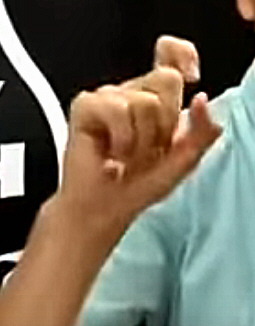
Source:
Abenchuchan, Alex (09/04/2019) coarticulated "e" from the fingerspelled word
"loophole", "Section: Updates on Texas shooter; clarifications on gun laws,"
News Brief: 09/04/2019, Publisher: The Daily Moth. Retrieved, 09/05/2019 from: < https://youtu.be/uHjWpK0vl2o?t=712
>

Coarticulated-T in "update."
Source:
Abenchuchan, Alex (09/04/2019) coarticulated "t" from the fingerspelled word
"update", "Section: Updates on Texas shooter; clarifications on gun laws," News
Brief: 09/04/2019, Publisher: The Daily Moth. Retrieved, 09/05/2019 from: <
https://youtu.be/uHjWpK0vl2o?t=770 >