Imagine if
American Sign Language Fingerspelling had existed during the Medieval Period.
How would monks and scribes have recorded the manual alphabet?
For a
possible answer to this thought experiment, we can look to how modern
fingerspelling might fit with writing systems of the time. In other words, a
fusion of Dactylology, Ogham, and Textura.
Dactylology is commonly known
as fingerspelling which is an aspect of sign language in which the fingers
are used to spell out words using a manual alphabet.
Ogham is an Early Medieval form of alphabet or cipher used primarily to write
the early Irish language, and later the Old Irish language.
Ogham inscriptions can be found on stone monuments scattered around the Irish
Sea. There are roughly 400 surviving orthodox inscriptions on stone monuments
throughout Ireland and western Britain. Ogham has an appearance or visual structure
that is somewhat reminiscent of fingers.
Textura is a family of scripts used in Western Europe from the 12th to the 17th
century and was commonly used in the creation of manuscripts and official
documentation. (Textura was the first typeface carved by Johannes
Gutenberg in the initial printing of the Bible.) Textura is of historical significance and its visually
compatible with Ogham.
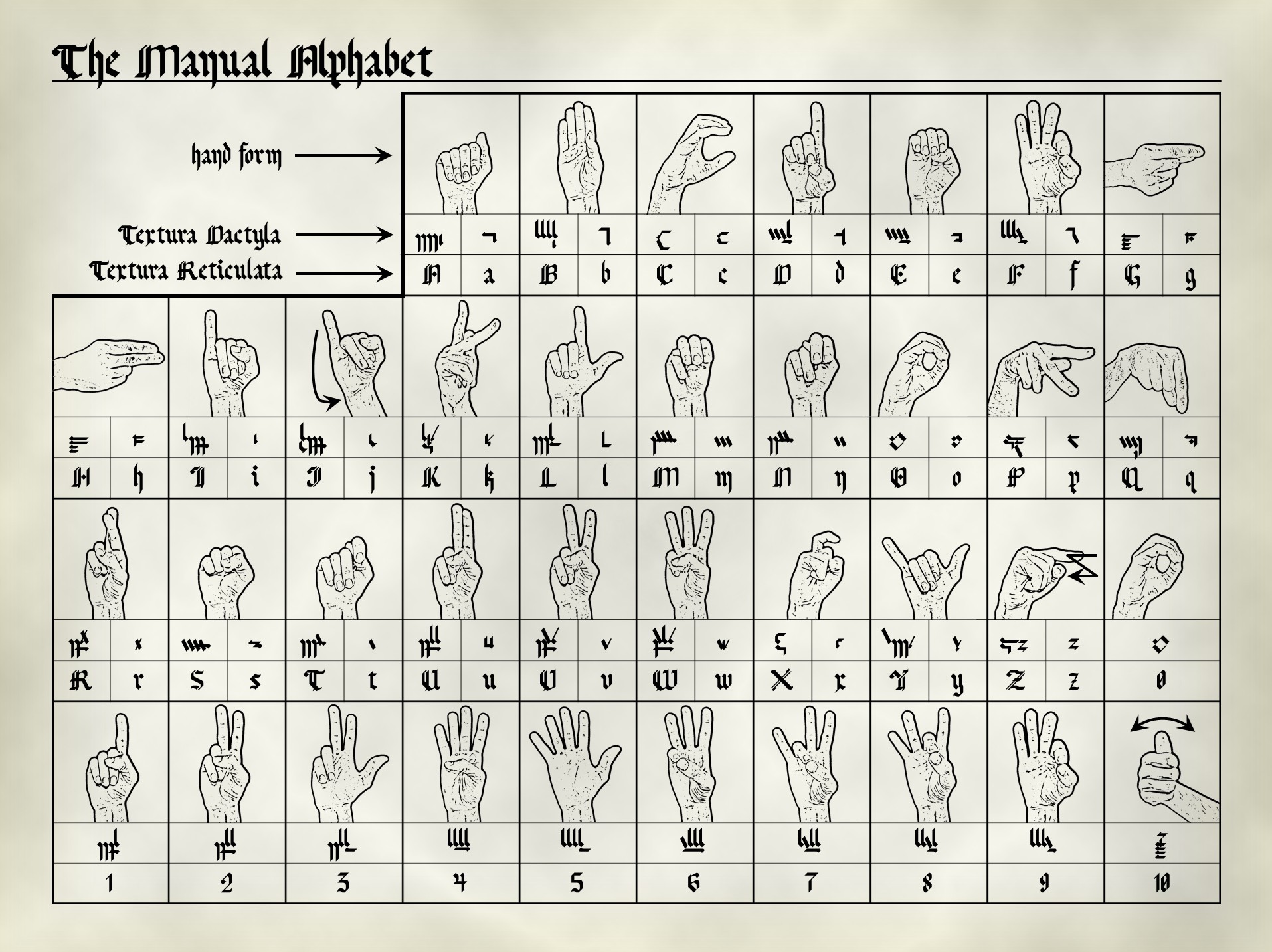
The result of this project is a new font
named "Textura-Dactyla."
"Textura-Dactyla" is a TrueType font that looks like calligraphic Ogham and yet is
generally reflective of the handshapes of the ASL manual alphabet.
The Textura-Dactyla font was designed by typographer* Shane
Smith in consultation with Dr. Bill Vicars of ASL University. It is
available to use under the Creative Commons Attribution license for any
purpose, commercial or otherwise, so long as attribution is given to the
original creator. For example, "Original font design by Shane Smith."
Download: ►Textura Dactyla (ttf)◄
Notes:
* Shane Smith is a lifelong student with particular interests in materials
engineering, computer programming, and archival science.
Notes: