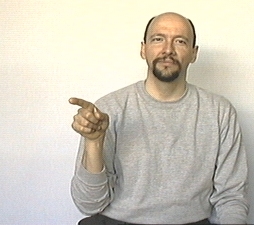
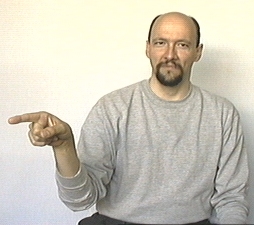
The general sign for "it" is done by simply pointing at the object to
which you are referring.
If the object, person, or location to which you are referring is present
(there in your immediate environment), you can just "point" at him or her.
If the referent isn't around you can just point off to your dominant side.
You can also point toward where something was. For example, suppose a person
was sitting in a certain chair and but recently got up and left, you can
point at the empty chair to refer to that person.
IT / HE / SHE / THERE / "the one that is right there"
Also see: THIS
Also see: THERE
QUESTION:
Hi Dr. Bill,
I have a question: what is "it" in ASL? I know that you point to the thing
if it is present, but what if I'm trying to say "It was great" or a sentence
that uses "it" in that context?
RESPONSE:
In a sentence such as:
"It was great!" -- the likelihood is that your conversation partner asked
you something like "What did you think of the movie?" (YOU LIKE MOVIE YOU?)
(MOVIE, GOOD?)
Thus the signed response could simply be to sign "GREAT!"
There is no need to sign "it" in such a situation because it is obvious as
to what you are referring.
Sometimes we just spell "it."
Check out this video:
https://www.youtube.com/watch?v=E6Jul2nXni4
QUESTION: How would you interpret "it"
in the sentence "What is it?" or "What was it"?
RESPONSE:
The right answer for many ASL questions presented out of context is: "Well,
it depends" -- followed by a dozen "if / then" scenarios.
A couple of common answers to how do you interpret "What is it?" include:
1. WHAT THAT?
2. WHATS-UP?
How to interpret the word "it" doesn't just depend on the co-locates (the
nearby words) but rather it also depends on what "it" is, how familiar with
"it" each person is, and the extent to which "it" has been discussed in the
past.
Sometimes you could sign "What is it?" by just doing a "What's up?" type
backward head jerk with furrowed eyebrows.
Or by scrunching up your nose and doing a slight head jerk.
Sometimes you could sign 'What is that?" by just doing a head jerk in the
direction of something along with a quick eye-gaze at the thing along with a
questioning facial expression.
You could even just pick something up and look at your conversation partner
quizzically.
Literally dozens of ways.
I'm going to tell you right now that you already know how to ask "What is
it?" -- Just give yourself permission to gesture and use your facial
expressions and match them to the situation.
Warning: You may see a Signed English version of "it" done by poking the
non-dominant palm with the tip of your pinkie finger (in an "i"-handshape.
That sign is not considered ASL but ASL interpreters should know that version in
case a client signs "it" that way.
Also see: INDEXING in ASL
Notes:
Where this sign is taught:
Reviewed in lessons: 30, 33Practice sentences using this sign:
IT WALL, what-COLOR?SUPPOSE DOG, YOU WATER "hose-down" YOU THINK IT STINK FUTURE-[will]?