The sign for "need" can be used to represent a number of related concepts.
Sign: need / need to / must / should / ought-to / have-to
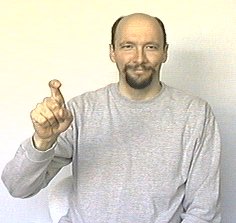
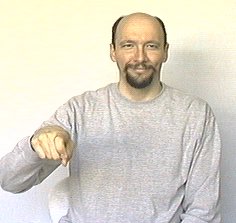
Handshape: "x"
Location: In front of you, off to the right side a bit.
Orientation: starts palm forward, ends palm down
Movement: "x" hand bends downward from the wrist
Non-Manual Marker (Facial expressions and or body language): Use a stronger facial expression to indicate a greater degree of imperative.
The faster, "harsher," and more exaggerated you do this sign, the more of a "requirement" exists to "do something." If you do this sign with a single, strong movement--it means need as in: must, have-to, "not much choice in the matter." If you use a double motion it means need as in: ought-to, should, "some choice in the matter."
0:00 / 0:00
"MUST or HAVE-TO" using a single motion:
The movement is downward. Starts and ends in an "x" handshape. The movement is mainly in the wrist not the arm.
"SHOULD, OUGHT-TO"
Use a double movement:
0:00 / 0:00
"SHOULD, OUGHT-TO" (side view):
MUST/HAVE-TO:
Let me give you an exaggerated example of this concept showing an extreme "HAVE-TO":
Notes:
<< In a message dated 5/10/2012 6:34:36 A.M. Pacific Daylight Time, Paul Dunn writes:
Dear Dr. Bill,
Just wondering about the sign for "need to." I see the sign for must/have-to, ought-to/should, and need....but what about specifically "need to."
For example, "i need to do my homework" and "i need money" use "need" in slightly different ways. I supposed the homework sentence is the
same as saying "i must do my homework"....either way, I have Deaf friends that all sign "need to" by using the sign for "need" and then fingerspelling "to." They themselves are not sure if they are using ESL or ASL when doing this.
Thanks!!
- Paul
>>
Dear Paul,
In ASL the sign "NEED" automatically includes the concept of "to." Thus you and your friends do not need to fingerspell nor sign "to" when signing the concept of "need to."
- Dr. Bill
In a message dated 7/7/2012 2:58:32 P.M. Pacific Daylight Time, a 12-year old young lady from the east coast writes:
"I wanted to know the difference between the ASK sign and the sign for NEED."
Thanks,
- Devon
Dear Devon,
ASK: Starts as a straight index finger that turns into an "X" as it moves toward the person being asked.
NEED: Starts as an "X" and bends at the wrist.
- Dr. Bill
In a message dated 8/4/2012 12:14:05 P.M. Pacific Daylight Time, sammydgp writes:
I am learning ASL via your website. I showed my mother the sign for "need" and she said that instead of moving my wrist, I should move my finger into a bent position, so that my finger is in the "e" position ( with my other fingers remaining still.) Is this an acceptable variation?
-Sammy
Dear Sammy,
I recommend you start with an "X"-handshape (the fingerspelled letter "X") and then bend it downward from the wrist.
If you start with a straight index finger and just bend the finger into an "X"-handshape then it looks a bit like the "qm-wig" (question mark wiggle) sign and/or the "ASK-to" sign.
So...at the risk of getting on your mom's crap list, I'm going to have to suggest that I don't think you should do it "her" way. Sorry.
- Dr. Bill
Topic: The sign: "NEED"
Question:
Is the sign for "need" also used to mean "should?" If so, how would you differentiate these two sentences:
1. "Do you need help?"
2. "You should help."
Answer:
In ASL the concepts "need / must / should / have to / ought to" all use the same general sign. Nuanced meanings of those concepts rely on context and inflections in the sign.
By context I mean the environment, the other words in the sentence, and the preexisting knowledge of the people in the conversation.
By inflections I mean the various changes that can be made to the sign such as doing the sign harder, softer, larger, smaller, with more intense facial expression, more gentle facial expression, two hands, or modifying the handshape to consist of four clawed fingers.
1. "Do you need help?" is signed using a yes/no facial expression (consisting of raised eyebrows and a slight forward tilt of the head).
https://youtu.be/6EAhWllIkAk
2. "You should help." is signed with a nod of the head and a facial expression matching the "affect" (the emotional content) you wish to convey. Additionally the sign may be done forcefully to indicate how strongly you feel about the other person's obligation to help.
You should tip the waiter/waitress/server how much?
https://youtu.be/zVAPZmXZDSM
Also see: don't-NEED



Notes:
Where this sign is taught:
Taught in Lesson 03.Reviewed in lessons: 05, 18, 21, 22, 26, 27, 42, 45
Practice sentences using this sign:
YOU NEED BATHROOM? (Do you need to go to the bathroom?)I NEED BRUSH-TEETH? (Do I need to brush my teeth?)
LEARN SIGN, NEED HELP YOU? (Do you need help learning sign language?)
YOU NEED GO DOCTOR? (Do you need to go to the doctor?)
YOU THINK TEACHER NEED STAND? (Do you think teachers should stand?)
YOU THINK CHILDREN SHOULD PUT- THEIR TOYS? (Do you think children should put away their toys?)
CLOTHES DIRTY, SHOULD PUT WHERE? (Where should we put dirty clothes?)
YOU THINK CHILDREN SHOULD CHANGE UNDERWEAR DAILY? (Do you think children should change their underwear everyday?)
HOW-OLD MUST FOR GET HORSE? (How old do you have to be to get a horse?)
YOU THINK HARD-OF-HEARING SHOULD MARRY DEAF fs-OR HEARING? (Do you think hard-of-hearing people should marry Deaf people or Hearing people?)
... and 15 more practice sentences use this sign.